
Rittal 3450505 Wire Connection Terminal push-in 0.5–4 mm²
Industrial Material > Enclosures / Chassis > Power distribution components
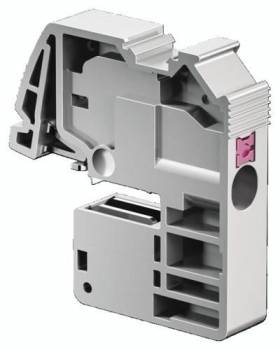
Rittal 3450505 Wire Connection Terminal push-in 0.5–4 mm²
| Lieske Part No. | 1087090 |
|---|---|
| Mfg Part No | 3450505 |
| EAN-Code | 4028177813960 |
| Manufacturer | Rittal |
| Here only | 11,96 EUR
14,23 EUR incl. VAT
|
Further information for Rittal 3450505 Wire Connection Terminal push-in 0.5–4 mm²
| General | |
| Applications | For use as busbar tap-off for L-, N- or PE-conductor in switching and control installations, and as conductor terminal block in meter cabinets. For mounting on busbars E-Cu or CUPONAL. |
| Function principle | Fully insulated terminal for tool-free wire connection, wire release via integrated release pin |
| Material | Polyamide, flammability rating according to UL 94-V0 |
| Colour | RAL 7042 |
| Test basis | IEC 60 999-1, IEC 60 947-7-1/-2 |
| Connection of stranded wires, fine-stranded with ferrule | 0,5 ‐ 4 mm² |
| Connection of round conductors, fine-stranded without ferrule | 0,5 ‐ 4 mm² |
| Connection of stranded wires, stranded | 0,5 ‐ 4 mm² |
| Connection of stranded wires, solid | 0,5 ‐ 6 mm² |
| For rail thickness | 5 mm |
| PCF/VE (Cradle-to-Gate) | 0.5 kg CO2 eq (Cat B) |
| Note on PCF class | Category B: PCF value (Cradle-to-Gate) approximately calculated based on product weight and self-declared |
Applications
This terminal is used in industrial and commercial electrical installations where quick and secure conductor connections are required. It is particularly suitable for installations involving frequent mounting and maintenance work, as it can be mounted and dismounted without tools. Its use in meter enclosures enables structured and clear wiring. The terminal is designed for use in switching installations where high reliability and maintenance-free operation are required.
Functions and Equipment in Detail
The SV 3450505 is a fully insulated terminal that ensures a secure electrical contact. The tool-free connection is achieved via the Push-in principle, where the conductor is simply inserted into the terminal. The conductor is released using an integrated release pin, which mechanically disengages the contact. The terminal housing features integrated labelling fields, enabling clear identification of connections. These labelling fields facilitate maintenance and fault diagnosis during operation.
Technology Explained Simply
The terminal supports various conductor types: single-core round conductors with a cross-section of 0.5 to 6 mm², as well as multi-core, fine-stranded round conductors with and without wire end ferrules in the range of 0.5 to 4 mm². The different cross-sections allow flexible adaptation to various requirements in electrical installation engineering. The polyamide insulation protects against short circuits and provides a high degree of protection against mechanical damage. The test basis IEC 60 999-1 and IEC 60 947-7-1/-2 ensures compliance with international standards for electrical connection and switching devices.
Compatibility and Accessories
The terminal is designed for mounting on standard busbars with a thickness of 5 mm, particularly for the E-Cu and CUPONAL profiles. These profiles are widely used in industrial electrical engineering and ensure stable fixation. The packaging unit is 10 pieces.
Mounting and Installation
Mounting is done by simply placing the terminal onto the busbar. The tool-free connection of conductors is achieved by pushing the conductor into the terminal until it reaches the stop. Release is done by actuating the integrated release pin. Installation is time-saving and requires no additional tools. The terminal is intended for use in enclosed switching installations, with mounting directly on the busbar.
Advantages in Operation
The terminal provides a maintenance-free connection, as no mechanical wear occurs due to tool application. The integrated labelling fields allow for clear and permanent identification, simplifying maintenance and servicing. Complete insulation protects against electrical hazards and ensures safe operation. Compatibility with various conductor cross-sections increases flexibility in planning and executing electrical installations.

This is an offer of:
79279 Vörstetten
https://industry-electronics.com
Tel. 07666/88499-0
Fax. 07666/88499-111
Diesen Artikel finden Sie unter:
industry-electronics.com/artikel/1087090

Lieske Elektronik e.K.
Reutener Str. 1079279 Vörstetten
https://industry-electronics.com
Tel. 07666/88499-0
Fax. 07666/88499-111
Diesen Artikel finden Sie unter:
industry-electronics.com/artikel/1087090