
RED 2716-10-0026 LWL-Duplex Patch Cable LC/SC 1.0 m OM4 violet
Networks > Fiber and Components
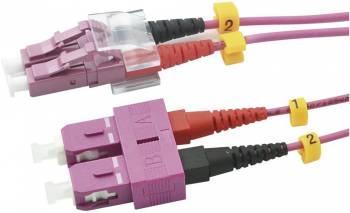
RED 2716-10-0026 LWL-Duplex Patch Cable LC/SC 1.0 m OM4 violet
| Lieske Part No. | 2023157 |
|---|---|
| Mfg Part No | 2716-10-0026 |
| EAN-Code | 4046725400370 |
| Manufacturer | RED |
| Here only | 7,06 EUR
8,40 EUR incl. VAT
|
Further information for RED 2716-10-0026 LWL-Duplex Patch Cable LC/SC 1.0 m OM4 violet
| General | |
| Fibre type | Multimode 50/125 µm |
| Category | OM4 |
| Number of fibres | 2 |
| Cable type | Duplex |
| Insertion loss at 850 nm | 0,3 dB |
| Sheath colour | Erika-Violet |
| Conductor material | Silicone |
| Sheathing | halogen-free (LSZH) |
| Operation temperature | -40 °C to +85 °C |
Applications
This LWL-Duplex patch cable is used in networks requiring multimode fibres, for example in local area networks (LAN), server and switch connections, as well as in structured cabling. The cable category OM4 enables high data transfer rates over short to medium distances, typically up to 550 metres at 10 Gbit/s. The use of multimode fibres with a core diameter of 50/125 µm is standard in many enterprise networks. The length of 1.0 m makes the cable particularly suitable for connections between devices in a rack or near switches and patch panels.
Functions and Equipment in Detail
The cable is designed as a duplex cable, meaning it contains two fibres, each transmitting data in opposite directions. The LC/SC connector configuration allows flexible connection to various optical interfaces. The connectors are fitted with end caps that protect against dust and contamination, extending the service life of the optical contacts. Additionally, the connectors are equipped with a duplex clip, enabling the swapping of the two channels. This is particularly useful when a cross-over connection is required, for example when connecting two identical devices without additional adapters.
Technology Explained Simply
The multimode 50/125 µm fibre type allows light signals to be transmitted via multiple light paths within the fibre, achieving high bandwidth. The OM4 category is a standard for multimode fibres, offering a maximum bandwidth of 4700 MHz·km at 850 nm. The insertion loss of 0.3 dB at 850 nm is within the typical range for high-quality LWL cables, ensuring minimal signal loss. The operating temperature range of -40 °C to +85 °C makes the cable suitable for use in various environments, including industrial facilities with extreme temperatures. The conductor material silicone ensures high flexibility and resistance to mechanical stress.
Compatibility and Accessories
The cable is compatible with standard LWL connectors LC and SC, which are widely used in IT infrastructure. It can be combined with other components that also support LC and SC connector types. As suitable accessories, the patch cable 151S1EOJO10E (SC-D/LC-D OM4, 1 m) is offered, which is also designed for multimode connections according to the OM4 standard. Combining it with other OM4 cables enables a consistent network architecture with high signal quality.
Installation and Mounting
Installation is carried out by simply plugging the connectors into the corresponding optical interfaces. The end caps should be removed before connection and reattached after connection to protect the connectors. The duplex clips facilitate correct insertion and help avoid incorrect connections. The cables are designed for use in racks, patch panels and switches and can be installed without additional tools.
Advantages in Operation
The halogen-free jacket (LSZH) increases safety in case of fire, as no toxic gases are released. The low insertion loss ensures stable signal transmission, and the robust construction with silicone conductor material guarantees a long service life. The colour coding in Erika-Violet supports cable management and reduces errors during installation. Compatibility with common connector types LC and SC simplifies integration into existing infrastructures.

This is an offer of:
79279 Vörstetten
https://industry-electronics.com
Tel. 07666/88499-0
Fax. 07666/88499-111
Diesen Artikel finden Sie unter:
industry-electronics.com/artikel/2023157

Lieske Elektronik e.K.
Reutener Str. 1079279 Vörstetten
https://industry-electronics.com
Tel. 07666/88499-0
Fax. 07666/88499-111
Diesen Artikel finden Sie unter:
industry-electronics.com/artikel/2023157