
RCS Audio-Systems RC-420 AB ceiling speaker 100 V white
100V Electro Acoustic Systems > Speakers > Ceiling mount Speakers
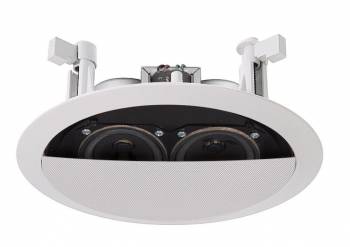
RCS Audio-Systems RC-420 AB ceiling speaker 100 V white
| Lieske Part No. | 654255 |
|---|---|
| Mfg Part No | RC-420 AB |
| EAN-Code | 4250458205151 |
| Manufacturer | RCS Audio-Systems |
| Here only | 83,60 EUR
99,48 EUR incl. VAT
|
Further information for RCS Audio-Systems RC-420 AB ceiling speaker 100 V white
| Technical data | |
| Frequency range (±10dB) | 90 – 16.000 Hz |
| Rated load capacity (program) | 2 x 10 (15) W |
| Cutout diameter Ø | 200 mm (±5mm) |
| Speaker | 2 St. 4" x2,5" |
| Impedance | 8 Ohm |
| Sound pressure level (SPL) 1 W/1 m | 96 dB |
| Colour | White |
| Shape | Round |
| Built-in depth | 70 mm |
| Beam angle (-6dB, 1 kHz) | 180° |
| Adjustments at 100 V | 2 x 10/5/2,5 W |
| Sound pressure level (SPL) Pmax/1 m | 113,4 dB @182Hz |
| Dimensions Ø | 226 mm |
Applications
This speaker is intended for use in buildings equipped with emergency call and alarm systems, particularly in public facilities, administrative buildings, schools, or hospitals, where redundant signal transmission is required. The A/B structure ensures that in the event of a failure in one line, the second line continues to provide reliable alarm signaling. The theft-secure mounting method allows for horizontal or vertical installation, enabling the speaker to be mounted in walls as well.
Functions and Equipment in Detail
The RC-420 AB is equipped with two 10,2 cm ( 4 inch ) x 6,3 cm ( 2,5 inch ) oval broadband chassis, each featuring a tweeter cone. This design ensures even sound dispersion across a frequency range of 90 to 16,000 Hz (±10 dB). The impedance is 8 Ohm, allowing standard compatibility with common amplifiers and wiring networks. The rated power handling is 2 x 10 W (program power), with a maximum power of 15 W. The sound pressure levels are 96 dB at 1 W/1 m and reach 113.4 dB at 182 Hz at maximum power. The dispersion angles are 180° at -6 dB and 1 kHz, ensuring broad, even coverage of the room.
Technology Explained Simply
The integrated 100-V transformers enable adaptation to 100-V lines, commonly used in professional sound systems. The tap settings are 2 x 10/5/2.5 W, allowing flexible power adjustment to match the respective line. The plastic housing is designed to minimize buzzing and unwanted vibrations. The use of two speakers and two transformers ensures redundant signal transmission, which is required to meet the specified standards.
Compatibility and Accessories
The speaker is compatible with 100-V networks and can be integrated into existing alarm systems. An optional humid environment version (Option FI-100) is available, where the chassis and transformers are specially impregnated for use in damp environments such as bathrooms or kitchens. For applications requiring special safety requirements, the BS-5839 option can be added, which includes a ceramic terminal, a thermal fuse, and fire-resistant cable. Custom painting is also available upon request.
Installation and Mounting
Installation is performed by inserting the speaker into a pre-drilled opening with a diameter of 200 mm ±5 mm. The installation depth is 70 mm. The theft-secure fastening allows flexible installation in ceilings or walls, with mounting possible in both horizontal and vertical orientations. Wiring is done via the integrated 100-V transformers, ensuring secure and redundant A/B cabling.
Operational Advantages
The RC-420 AB provides reliable and redundant signal transmission, meeting the requirements of alarm systems. The wide dispersion and high sound pressure level ensure clear and distinct reproduction of alarm and information messages. The robust construction and high-quality plastic housing ensure long service life and low maintenance. The ability to use the speaker in various environments—including humid and safety-compliant versions—increases flexibility in system planning.

This is an offer of:
79279 Vörstetten
https://industry-electronics.com
Tel. 07666/88499-0
Fax. 07666/88499-111
Diesen Artikel finden Sie unter:
industry-electronics.com/artikel/654255

Lieske Elektronik e.K.
Reutener Str. 1079279 Vörstetten
https://industry-electronics.com
Tel. 07666/88499-0
Fax. 07666/88499-111
Diesen Artikel finden Sie unter:
industry-electronics.com/artikel/654255