
RCS Audio-Systems MXA-4120A 4-channel mixer amplifier 2 HE
100V Electro Acoustic Systems > Amplifiers
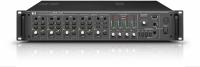
RCS Audio-Systems MXA-4120A 4-channel mixer amplifier 2 HE
| Lieske Part No. | 904444 |
|---|---|
| Mfg Part No | MXA-4120 A |
| EAN-Code | 4250458263151 |
| Manufacturer | RCS Audio-Systems |
| Here only | 1.767,00 EUR
2.102,73 EUR incl. VAT
|
Further information for RCS Audio-Systems MXA-4120A 4-channel mixer amplifier 2 HE
| Technical data | |
| Outputs, speakers | 100 V or 70 V and low-impedance 4 Ohm |
| Frequency range | 45 - 20.000 Hz (-3dB) |
| Total harmonic distortion | better than 0.3% at 1 kHz |
| Power supplies | 230 V mains power (50/60 Hz) and 24 V DC (emergency power supply) |
| Power consumption | 1317 W – 1/8: 3.28 A – rated: 7.16 A |
| Outputs | REC OUT: 0 dBu (775 mV), 3 kOhm, unbalanced; MONITOR: 0 dBu (775 mV), 200 Ohm, unbalanced; FAULT: Relay with changeover contact, 24 V max. 500 mA 24 V; EMER. OUT: 24 V DC 200 mA for mandatory reception relay |
| Noise level | MIC: better than 75dB; LINE: better than 90dB |
| Inputs | MIC/LINE 1-3: -50 dBu (2.45 mV), 5 kOhm, symmetrical; MIC/LINE 1-3: -10 dBu (245 mV), 15 kOhm, symmetrical; LINE 4-5: -10 dBu (245 mV), 15 kOhm, symmetrical; PAGING: -10 dBu (245 mV), 10 kOhm, symmetrical |
| Dimensions (W x H x D) | 483 x 88 x 352 mm; 2 HE |
| Output power | 4x 120 W RMS (max. 4x 180W) |
Applications
This amplifier is suitable for applications in multi-zone buildings such as schools, hospitals, office complexes, or industrial facilities, where central, zone-specific sound reinforcement is required. The integrated matrix enables flexible signal distribution, allowing different sources such as microphones, music signals, or emergency systems to be directed independently to different zones. Support for backup power supply via 24 V DC makes it suitable for critical applications where interruption of sound reinforcement is not acceptable.
Functions and Equipment in Detail
Inputs 1 to 3 are switchable between MIC and LINE signals and feature a gain control as well as switchable phantom power. These inputs always have priority over inputs 4 and 5. Inputs 1–3 are equipped with combo jacks, while inputs 4 and 5 use RCA jacks. Each of the five inputs has separate volume, treble, and bass controls. A PAGING input on screw terminals allows connection to telephone paging systems with highest priority. Additionally, there are contacts for remote control of an integrated gong (2- or 4-tone) before announcements, as well as for triggering a siren (all-call). An integrated control speaker with zone selection and volume control enables on-site function testing.
Technology Explained Simply
The matrix function allows five different signal sources (e.g. microphone, music, emergency) to be distributed to four different speaker zones, with each zone being independently controllable. The outputs are designed for 100 V and 70 V high-voltage lines as well as for 4-Ohm low-impedance amplification, enabling flexible connection to existing speaker systems. Power supply is via 230 V mains (50/60 Hz) or 24 V DC (backup power supply), ensuring continuous operation even during power failure. Power consumption during operation is 1317 W, with a rated current of 7.16 A.
Compatibility and Accessories
The MXA-4120A is specifically designed for use with the call stations VLM-100A, MXM-104, and MXE-400W. Up to four wall-mounted call stations MXE-400W can be connected, with one call station assigned per zone. The MXE-400W call station features an integrated text memory with a maximum recording duration of 60 seconds. The MXM-104 call station enables remote control of the four speaker zones and triggering of an all-call signal. The VLM-100A call station offers digital control with zone selection and status indication via LEDs.
Mounting and Installation
The amplifier has dimensions of 483 x 88 x 352 mm (W x H x D) and is built in a 2 U format, making it suitable for installation in standard 19-inch racks. Installation requires connection to a 230 V mains power supply as well as wiring of the speaker zones and input signals. The connections are clearly labeled and include, among others, speaker outputs, inputs for microphones and line signals, the PAGING input, the control speaker, and the fault alarm output.
Advantages in Operation
The MXA-4120A offers high flexibility through the integrated matrix, clear signal processing with low distortion and high noise level, as well as the possibility of backup power supply. The separate control of volume, treble, and bass per input enables precise tone adjustment. Integrated control functions such as the control speaker and fault alarm output (changeover contact) facilitate maintenance and monitoring. Compatibility with various call stations expands the range of applications in complex sound reinforcement systems.
Functions and Equipment in Detail
Inputs 1–3 are switchable between MIC and LINE signals and feature a gain control as well as switchable phantom power. These inputs always have priority over inputs 4 and 5. Inputs 1–3 are equipped with combo jacks, while inputs 4 and 5 use RCA jacks. Each of the five inputs has separate volume, treble, and bass controls. A PAGING input on screw terminals allows connection to telephone paging systems with highest priority. Additionally, there are contacts for remote control of an integrated gong (2- or 4-tone) before announcements, as well as for triggering a siren (all-call). An integrated control speaker with zone selection and volume control enables on-site function testing.
Technology Explained Simply
The matrix function allows five different signal sources (e.g. microphone, music, emergency) to be distributed to four different speaker zones, with each zone being independently controllable. The outputs are designed for 100 V and 70 V high-voltage lines as well as for 4-Ohm low-impedance amplification, enabling flexible connection to existing speaker systems. Power supply is via 230 V mains (50/60 Hz) or 24 V DC (backup power supply), ensuring continuous operation even during power failure. Power consumption during operation is 1317 W, with a rated current of 7.16 A.
Compatibility and Accessories
The MXA-4120A is specifically designed for use with the call stations VLM-100A, MXM-104, and MXE-400W. Up to four wall-mounted call stations MXE-400W can be connected, with one call station assigned per zone. The MXE-400W call station features an integrated text memory with a maximum recording duration of 60 seconds. The MXM-104 call station enables remote control of the four speaker zones and triggering of an all-call signal. The VLM-100A call station offers digital control with zone selection and status indication via LEDs.
Mounting and Installation
The amplifier has dimensions of 483 x 88 x 352 mm (W x H x D) and is built in a 2 U format, making it suitable for installation in standard 19-inch racks. Installation requires connection to a 230 V mains power supply as well as wiring of the speaker zones and input signals. The connections are clearly labeled and include, among others, speaker outputs, inputs for microphones and line signals, the PAGING input, the control speaker, and the fault alarm output.
Advantages in Operation
The MXA-4120A offers high flexibility through the integrated matrix, clear signal processing with low distortion and high noise level, as well as the possibility of backup power supply. The separate control of volume, treble, and bass per input enables precise tone adjustment. Integrated control functions such as the control speaker and fault alarm output (changeover contact) facilitate maintenance and monitoring. Compatibility with various call stations expands the range of applications in complex sound reinforcement systems.

This is an offer of:
79279 Vörstetten
https://industry-electronics.com
Tel. 07666/88499-0
Fax. 07666/88499-111
Diesen Artikel finden Sie unter:
industry-electronics.com/artikel/904444

Lieske Elektronik e.K.
Reutener Str. 1079279 Vörstetten
https://industry-electronics.com
Tel. 07666/88499-0
Fax. 07666/88499-111
Diesen Artikel finden Sie unter:
industry-electronics.com/artikel/904444