
RAK Wireless 915007 LoRa Antenna 868 MHz Fiberglass
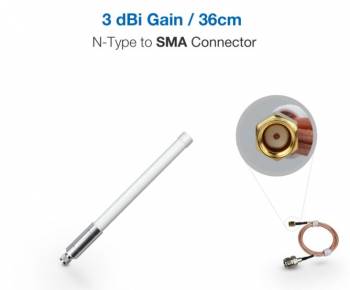
RAK Wireless 915007 LoRa Antenna 868 MHz Fiberglass
| Lieske Part No. | 1787794 |
|---|---|
| Mfg Part No | 915007 |
| EAN-Code | |
| Manufacturer | RAK Wireless |
| Here only | 33,31 EUR
39,64 EUR incl. VAT
|
Further information for RAK Wireless 915007 LoRa Antenna 868 MHz Fiberglass
| General | |
| Frequency range | 860 - 930 MHz |
| Gain | 2,6 ~ 3,1 dBi |
| VSWR | < 2,5 |
| Beam width | 360° |
| Impedance | 50 Ohm |
| Polarisation | Vertical |
| Radome body | Fiberglass |
| Connection | N-type connector |
| Operation temperature | -20 ~ +65 °C |
| Storage temperature | -30 ~ +75 °C |
| Scope of delivery | 1x antenna, 1x pigtail interface converter |
Applications
The antenna is intended for LoRa-IoT networks, particularly in combination with LoRa gateways. It is suitable for applications such as remote monitoring, Smart City systems, industrial sensor networks, and other IoT solutions where reliable, long-range communication is required. The frequency range of 860 to 930 MHz covers common LoRa bands in Europe and other regions, with the exact frequency selection depending on local parameters, as described in the TTN guide or LoRa Alliance documentation.
Features and Specifications in Detail
The antenna is equipped with an N-type connector, ensuring a secure and robust connection to the gateway. The impedance is 50 Ohm, which is the standard impedance for radio applications and enables optimal signal transmission without reflections. The polarization is vertical, which is typical for LoRa systems and ensures compatibility with most end devices. The radome body is made of fiberglass, providing high mechanical stability and weather resistance. The antenna is designed for operating temperatures from -20 °C to +65 °C, making it suitable for use in various climate zones.
Technical Explanation
A gain of 2.6 to 3.1 dBi means the antenna amplifies the signal by this amount, improving range and signal quality. A VSWR value below 2.5 indicates good impedance matching, meaning only a small portion of the transmitted power is reflected. The 360° beamwidth ensures the antenna transmits and receives evenly in all directions, which is particularly advantageous for sites with irregular surroundings or for covering large areas. The fiberglass housing protects the internal antenna structure from external influences such as moisture, UV radiation, or mechanical stress.
Compatibility and Accessories
The antenna is compatible with all LoRa gateways that support an N-type connector. It can be connected to various LoRa-IoT sensors and devices operating in the 860 to 930 MHz frequency range. The delivery includes, in addition to the antenna, a pigtail interface converter, which facilitates connection to the gateway. The antenna is not designed for use with other frequency bands or other antenna types, such as directional antennas, which require targeted coverage in a specific direction.
Mounting and Installation
The antenna can be mounted on a mast, roof, or other suitable structure. Mounting is done via the N-type connector, which connects to the gateway. The pigtail interface converter simplifies the connection, especially if the gateway has a different connector than N-type. The antenna should be installed as high as possible and free from obstructions to achieve maximum range. Dimensions are ø 25 mm x 360 mm ± 10 mm, enabling a compact design.
Operational Advantages
The antenna provides reliable and long-range communication for LoRa-IoT networks. The omnidirectional radiation pattern ensures even coverage, and the high mechanical stability of the fiberglass radome ensures long service life even under harsh environmental conditions. The operating temperature range of -20 °C to +65 °C makes the antenna suitable for use in various climate zones. The use of an N-type connector and the pigtail converter simplifies installation and integration into existing systems.

This is an offer of:
79279 Vörstetten
https://industry-electronics.com
Tel. 07666/88499-0
Fax. 07666/88499-111
Diesen Artikel finden Sie unter:
industry-electronics.com/artikel/1787794

Lieske Elektronik e.K.
Reutener Str. 1079279 Vörstetten
https://industry-electronics.com
Tel. 07666/88499-0
Fax. 07666/88499-111
Diesen Artikel finden Sie unter:
industry-electronics.com/artikel/1787794