
Phoenix Contact 3036369 Fuse Terminal Block ST 4-HESI
Industrial Material > Connection technology > Terminals
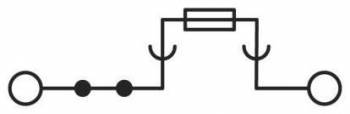
Phoenix Contact 3036369 Fuse Terminal Block ST 4-HESI
| Lieske Part No. | 304177 |
|---|---|
| Mfg Part No | 3036369 |
| EAN-Code | 4017918890476 |
| Manufacturer | Phoenix Contact |
| Here only | 6,33 EUR
7,53 EUR incl. VAT
|
Further information for Phoenix Contact 3036369 Fuse Terminal Block ST 4-HESI
| General | |
| Safety device type | Glass / Ceramic / ... |
| Fuse type | G / 5 x 20 |
| Nominal voltage | 500 V |
| Nominal current | 6,3 A |
| Connection type | tension spring connection |
| Rated cross-sectional area | 4 mm² |
| Cross section | 0,08–6 mm² |
| Mounting method | NS 35/7,5, NS 35/15 |
| Colour | Black |
Applications
This terminal block is suitable for use in industrial electrical installations, such as machine controls, distribution enclosures, or automation technology systems. It is used where secure and easily accessible protection of individual lines is required. The use of glass or ceramic fuses enables high thermal stability and good visibility of the fuse status. Mounting on NS 35 rails is standard in industrial electrical engineering, allowing the terminal block to be easily integrated into existing systems.
Functions and Equipment in Detail
The ST 4-HESI (5X20) features a spring clamp connection, enabling quick and tool-free connection of wires. The rated cross-section is 4 mm², with the actual connection cross-section ranging from 0.08 mm² to 6 mm². This range covers most common cable cross-sections in industrial applications. The spring clamp ensures a secure connection, even under vibration or mechanical stress, and reduces the risk of contact loss. The terminal block is rated for a nominal voltage of 500 V and a nominal current of 6.3 A, making it suitable for medium to high loads in industrial electrical engineering.
Technology Explained Simply
The spring clamp technology works without screwdrivers: the wire is simply inserted into the connection, where the spring automatically establishes contact. The spring force ensures a stable electrical connection, even under temperature fluctuations or mechanical stress. The fuse is inserted into the designated slot, with the 5 x 20 mm dimensions being standardized and compatible with common fuses. The terminal block is designed for use with glass or ceramic fuses, which offer high thermal resistance and clear visibility of the status (intact/defective).
Compatibility and Accessories
The terminal block can be combined with various accessories that extend its functionality. These include jumper bridges in different pole counts (e.g. 2-pole, 4-pole, 5-pole, 10-pole, 20-pole), enabling parallel connection of multiple terminal blocks. Partition plates (e.g. ATP-ST 4) are used for visual and electrical separation of terminal blocks. Labelling markers (e.g. UC-TM 5, UCT-TM 5 CUS) allow clear identification of individual connections. End holders and end caps (e.g. E/AL-NS 35, NS 35/7,5 CAP) serve as end sealing and protection for a terminal block series. Label strips (e.g. ZBF 6 CUS, ZB 5 CUS) allow individual labelling according to customer requirements.
Mounting and Installation
Mounting is done on NS 35/7,5 or NS 35/15 support rails, which are standard in industrial electrical engineering. The terminal block is simply slid onto the rail and held securely by a spring mechanism. Wires are connected via the spring clamp connection, with cross-sections ranging from 0.08 mm² to 6 mm². The fuse is inserted into the designated slot. No tools are required for mounting, which speeds up installation and reduces the risk of errors.
Advantages in Operation
The terminal block offers high operational safety thanks to the spring clamp connection, which ensures a stable connection even under dynamic conditions. The clear visibility of the fuse enables quick fault diagnosis. Compatibility with various accessories allows flexible adaptation to different requirements. Mounting on standard support rails ensures universal usability in various control systems. The nominal values of 500 V and 6.3 A cover a wide range of industrial applications.

This is an offer of:
79279 Vörstetten
https://industry-electronics.com
Tel. 07666/88499-0
Fax. 07666/88499-111
Diesen Artikel finden Sie unter:
industry-electronics.com/artikel/304177

Lieske Elektronik e.K.
Reutener Str. 1079279 Vörstetten
https://industry-electronics.com
Tel. 07666/88499-0
Fax. 07666/88499-111
Diesen Artikel finden Sie unter:
industry-electronics.com/artikel/304177