
Phoenix Contact 2967060 Relay Module PLC-RSC- 24DC/21-21
Industrial Material > Industrial relays and contactors > Electronic modules
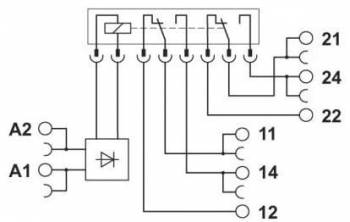
Phoenix Contact 2967060 Relay Module PLC-RSC- 24DC/21-21
| Lieske Part No. | 413186 |
|---|---|
| Mfg Part No | 2967060 |
| EAN-Code | 4017918156374 |
| Manufacturer | Phoenix Contact |
| Here only | 18,62 EUR
22,16 EUR incl. VAT
|
Further information for Phoenix Contact 2967060 Relay Module PLC-RSC- 24DC/21-21
| General | |
| Product type | Relay module |
| Input voltage | 24 V DC |
| Number of changeover contacts | 2 |
| Mounting method | DIN rail NS 35/7.5 |
| Connection type | Screw connection |
| Components | Base terminal PLC-BSC.../21 with plug-in miniature relay |
Applications
This relay module is used in industrial automation technology, particularly in control systems operating with a PLC (Programmable Logic Controller). It serves as an interface between the control system and external loads, such as motors, heaters, or lighting systems. Mounting on the support rail NS 35/7,5 enables modular and compact installation in enclosures. The screw connections on the base terminal ensure a secure and mechanically stable connection, suitable for industrial environments.
Functions and Equipment in Detail
The module combines a base terminal with a plug-in miniature relay, enabling flexible and maintenance-friendly configuration. The relay is equipped with two changeover contacts, allowing multiple switching operations to be controlled in parallel or sequentially. The input voltage of 24 V DC is a standard value in automation technology and is commonly used in control systems and sensors. The power contacts of the relay are designed for connecting loads that exceed the control voltage, achieving galvanic isolation between control and load.
Technology Explained Simply
The base terminal PLC-BSC.../21 provides a screw connection ensuring a secure electrical connection. The plug-in miniature relay allows the module to be removed or replaced without tools, simplifying maintenance and servicing. The use of two changeover contacts means the relay can control two separate circuits, with each contact switching independently. The input voltage of 24 V DC is supplied via the base terminal and activates the relay when a signal is present. The output contacts then switch the connected loads on or off.
Compatibility and Accessories
The module is compatible with the support rail NS 35/7,5, widely used in industrial electrical engineering. Suitable accessories include various markers for terminals, such as UCT-TM 12, UC-TM 12, UC-TM 10, as well as labelable flag markers like ZB10,LGS:L1-N,PE or ZB 12,LGS:L1-N,PE. Additionally, endless jumper bridges (e.g. FBST 500-PLC RD), single jumper bridges (e.g. FBST 6-PLC GY), feed-in terminals (PLC-ESK GY), and partition plates (PLC-ATP BK) are available to support mounting and labeling in enclosures. System connectors such as PLC-V8L/FLK14/OUT enable structured cabling.
Mounting and Installation
Mounting is performed on the support rail NS 35/7,5 by simply plugging the module onto the rail. The screw connections on the base terminal are connected to the corresponding wires. Wiring is carried out according to the electrical circuit diagrams, with the input voltage of 24 V DC connected to the input terminals of the base terminal. The relay output contacts are connected to the loads to be controlled. Labeling the terminals with the provided markers or flag markers facilitates identification and maintenance.
Advantages in Operation
The module offers a compact and modular solution for signal conversion in control systems. The plug-in design of the relay enables quick maintenance and replacement without tools. The use of two changeover contacts extends functionality, allowing multiple switching operations to be performed in parallel. The screw connections ensure a stable connection that remains reliable even under industrial conditions. Compatibility with standard support rails and accessories simplifies integration into existing systems.

This is an offer of:
79279 Vörstetten
https://industry-electronics.com
Tel. 07666/88499-0
Fax. 07666/88499-111
Diesen Artikel finden Sie unter:
industry-electronics.com/artikel/413186

Lieske Elektronik e.K.
Reutener Str. 1079279 Vörstetten
https://industry-electronics.com
Tel. 07666/88499-0
Fax. 07666/88499-111
Diesen Artikel finden Sie unter:
industry-electronics.com/artikel/413186