
Phoenix Contact 2943259 EMG 17-OV-TTL/ 24DC/2 solid-state relay module
Industrial Material > Industrial relays and contactors > Electronic modules
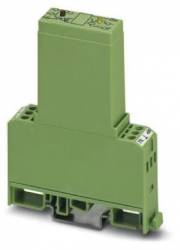
Phoenix Contact 2943259 EMG 17-OV-TTL/ 24DC/2 solid-state relay module
| Lieske Part No. | 352353 |
|---|---|
| Mfg Part No | 2943259 |
| EAN-Code | 4017918107543 |
| Manufacturer | Phoenix Contact |
| Here only | 1.837,30 EUR
2.186,39 EUR incl. VAT
|
Further information for Phoenix Contact 2943259 EMG 17-OV-TTL/ 24DC/2 solid-state relay module
| General | |
| Degree of protection | short-circuit proof |
| Input voltage | 5 V DC |
| Input signal | TTL |
| Output voltage | 24 V DC |
| Maximum output current | 2 A |
| Protection circuitry | in input and output circuits |
| Indicator light | |
Applications
This relay is suitable for applications requiring high switching frequency, long service life, and high reliability. Typical use cases include controlling motors, heaters, pumps, or other electrical consumers in manufacturing and process automation. The galvanic isolation between the input and output circuits protects the control electronics from disturbances and voltage spikes from the load circuit. The output operating voltage is 24 V DC, which is a standard value in industrial electronics. The maximum output current of 2 A enables control of loads with corresponding power requirements.
Functions and Features in Detail
The device features an indicator light that visually signals the switching state. This facilitates diagnosis and maintenance, as the operating status can be directly read on the device. Integrated protection circuitry in the input and output circuits protects the device against transient voltage disturbances, overvoltages, and short circuits. The output side is short-circuit proof, meaning the relay will not be damaged even in the event of a short circuit in the load circuit, but will indicate the fault condition and switch off the load. The input voltage is 5 V DC in TTL format, which is compatible with standard control systems.
Technology Explained Simply
A Solid-State-Relay (SSR) operates without mechanical contacts, instead using semiconductor components such as thyristors or transistors for current conduction. This results in a significantly longer service life compared to mechanical relays, as there is no mechanical wear. The switching speed is very high, which is advantageous for fast control sequences. Galvanic isolation between input and output is achieved via an optocoupled circuit, ensuring that disturbances in the load circuit do not affect the control system. The protection circuitry in the input and output circuits ensures higher operational safety and extends the device's lifespan.
Compatibility and Accessories
The relay is designed for use with control systems that provide TTL signals at 5 V DC. It is compatible with standard terminal strips in enclosures and can be integrated into existing automation systems. The output voltage of 24 V DC is a common value in industrial electronics, making it compatible with many loads.
Mounting and Installation
Mounting is done on a standard terminal strip, commonly used in enclosures. Installation requires no special tools, and wiring follows standard electrical installation rules. The indicator light allows for easy verification of the operating status after installation.
Advantages in Operation
The relay offers high operational safety due to the integrated protection circuitry and short-circuit-proof design. Galvanic isolation protects the control electronics. The long service life and high switching speed make it particularly suitable for applications with high switching frequencies. The visual indicator simplifies maintenance and fault diagnosis. Compatibility with TTL signals and 24 V DC loads makes it universally applicable in industrial automation technology.

This is an offer of:
79279 Vörstetten
https://industry-electronics.com
Tel. 07666/88499-0
Fax. 07666/88499-111
Diesen Artikel finden Sie unter:
industry-electronics.com/artikel/352353

Lieske Elektronik e.K.
Reutener Str. 1079279 Vörstetten
https://industry-electronics.com
Tel. 07666/88499-0
Fax. 07666/88499-111
Diesen Artikel finden Sie unter:
industry-electronics.com/artikel/352353