
Phoenix Contact 2910537 PLC-RPT- 24DC/2X21/FG relay module
Installation > Modular devices / equipment installation > Impulse switch / relay
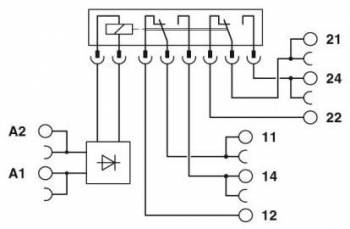
Phoenix Contact 2910537 PLC-RPT- 24DC/2X21/FG relay module
| Lieske Part No. | 1004461 |
|---|---|
| Mfg Part No | 2910537 |
| EAN-Code | 4055626486055 |
| Manufacturer | Phoenix Contact |
| Here only | 40,75 EUR
48,49 EUR incl. VAT
|
Further information for Phoenix Contact 2910537 PLC-RPT- 24DC/2X21/FG relay module
| General | |
| Input voltage | 24 V DC |
| Number of changeover contacts | 2 |
| Contact type | Positive engagement |
| Connection system | Push-in |
| Norm | DIN EN 61810-3 |
| Module type | Relay module |
| Connection type | Pluggable |
Applications
This relay module is used in industrial automation technology, particularly in systems requiring galvanic isolation between control and load. It is suitable for applications in manufacturing automation, machine control, and process regulation, where secure signal transmission and protection against interference are required. The forced-guided contacts in accordance with DIN EN 61810-3 ensure reliable switching function, even under high mechanical stress.
Functions and equipment in detail
The module features two changeover contacts, each providing one switching contact and one return contact. The contacts are forced-guided, meaning they are mechanically linked to ensure simultaneous opening and closing. This increases safety in critical applications. An integrated freewheeling diode protects the control system from inductive voltage spikes that may occur when switching inductive loads. The input voltage is 24 V DC, which is a standard supply voltage in automation technology.
Technology explained simply
The Push-in connection technology enables quick and tool-free connection of wires. Cables are simply inserted into the connection terminals, where a spring-loaded holding mechanism secures the contact. This reduces installation time and minimizes error susceptibility. The forced-guided contacts ensure all contacts switch simultaneously, which is important for safety applications. The freewheeling diode protects the control electronics by diverting inductive voltage spikes generated when switching coils or motors off.
Compatibility and accessories
The module is compatible with various accessories that facilitate operation and identification of connections. These include, for example, terminal strips in various versions (e.g. ZB10,LGS:U-N, ZB 12,LGS:L1-N,PE, ZB 10 unprinted), used for labeling connections. Screwdrivers (SZF 1-0,6X3,5) and terminal markers (UC-TM 10 CUS, UCT-TM 10, UC-TM 12) support installation and maintenance. Additionally, individual and endless jumper bridges (FBST 6-PLC RD, FBST 500-PLC BU) are available to connect multiple terminals. A power supply terminal (PLC-ESK GY) can be used to supply power to the module.
Installation and mounting
The relay module is plugged onto a standard 35 mm rail mounting plate. Installation is tool-free, as the terminals are equipped with Push-in technology. Connections are made by simply inserting the wires into the terminals. Positioning typically occurs in enclosures, where the module is installed in series with other components. The installation orientation is unrestricted, although the ambient temperature should remain within the specified operating conditions.
Advantages in operation
The use of forced-guided contacts increases the reliability and safety of the circuit. Push-in connections reduce installation time and minimize the risk of incorrect connections. The integrated freewheeling diode protects the control electronics from damage caused by inductive voltage spikes. The module is designed for industrial environments and provides a robust, low-maintenance solution for signal transmission between control and load.

This is an offer of:
79279 Vörstetten
https://industry-electronics.com
Tel. 07666/88499-0
Fax. 07666/88499-111
Diesen Artikel finden Sie unter:
industry-electronics.com/artikel/1004461

Lieske Elektronik e.K.
Reutener Str. 1079279 Vörstetten
https://industry-electronics.com
Tel. 07666/88499-0
Fax. 07666/88499-111
Diesen Artikel finden Sie unter:
industry-electronics.com/artikel/1004461