
Phoenix Contact 2903334 Relay Module RIF-1-RPT-LDP-24DC/2X21
Installation > Modular devices / equipment installation > Impulse switch / relay
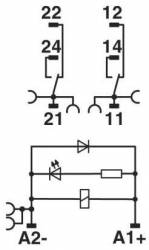
Phoenix Contact 2903334 Relay Module RIF-1-RPT-LDP-24DC/2X21
| Lieske Part No. | 374581 |
|---|---|
| Mfg Part No | 2903334 |
| EAN-Code | 4046356732277 |
| Manufacturer | Phoenix Contact |
| Here only | 11,11 EUR
13,22 EUR incl. VAT
|
Further information for Phoenix Contact 2903334 Relay Module RIF-1-RPT-LDP-24DC/2X21
| General | |
| Contact type | 2 change-over contacts |
| Input voltage | 24 V DC |
| Connection system | Push-in |
| Module type | pre-assembled relay module |
| Mounting format | NS 35/15 |
| Integrated functions | Display and noise suppression module |
| Components | relay socket, power contact relay, indicator/noise suppression module, retaining bracket |
Applications
The module is intended for use in industrial control systems, such as in manufacturing automation, building technology, or machine construction. It is suitable for signal amplification, separation of control and load circuits, and logic implementation in electrical circuits. The pre-assembled design reduces installation time and minimizes error sources, as all components are pre-assembled.
Functions and Equipment in Detail
The relay module features a push-in connection, enabling quick and secure connection of wires without requiring additional tools such as screwdrivers. The contacts are configured as two changeover contacts, meaning each contact can switch a circuit between two positions (e.g., open/closed). This is particularly useful for complex switching logic, where multiple states must be switched depending on a signal. The integrated indicator and interference suppressor module enables visual monitoring of the relay status and reduces interference in the circuit caused by electromagnetic disturbances.
Technology Explained Simply
The module operates with a supply voltage of 24 V DC, typical for industrial control systems. The voltage is supplied via the push-in connection and activates the relay as soon as a signal is present. The contacts then switch the load circuit, which can drive, for example, a lamp, motor, or other consumer. The use of an interference suppressor module ensures that switching operations do not cause interference in adjacent wires, increasing the overall reliability of the system. The pre-assembled design reduces the number of necessary installation steps and minimizes the risk of incorrect connections.
Compatibility and Accessories
The relay module is designed for mounting in standard rail systems in the NS 35/15 format. It can be supplemented with various accessories for marking, insulation, or mechanical fixation of wires. These include, for example, jumper bridges (e.g. FBS 2-6 GY), terminal markers (e.g. UC-TM 16), insulating sleeves in various colors (e.g. MPS-IH GN, MPS-IH BU), and wire marking bands (e.g. ZB 5 :UNBEDRUCKT). These elements support structured and error-free installation and maintenance of the module.
Mounting and Installation
Installation is performed by simply inserting the module into the designated rail. The push-in connections allow direct insertion of wires without additional tools. Mechanical stability is ensured by the integrated retaining clip, which securely fixes the module in the rail. Installation is thus quick and requires no special skills, improving the maintainability and expandability of the system.
Advantages in Operation
The module offers high operational safety due to the integrated interference suppression and robust construction. The visual indicator enables quick diagnosis during operation, as the relay status is directly visible. The pre-assembled design reduces installation time and minimizes error sources. The use of push-in connections increases efficiency during installation and maintenance, as no additional tools are required. Compatibility with standard rail systems and accessories ensures flexible integration into existing systems.

This is an offer of:
79279 Vörstetten
https://industry-electronics.com
Tel. 07666/88499-0
Fax. 07666/88499-111
Diesen Artikel finden Sie unter:
industry-electronics.com/artikel/374581

Lieske Elektronik e.K.
Reutener Str. 1079279 Vörstetten
https://industry-electronics.com
Tel. 07666/88499-0
Fax. 07666/88499-111
Diesen Artikel finden Sie unter:
industry-electronics.com/artikel/374581