
Phoenix Contact 2903294 relay module RIF-3-RPT-LDP-24DC/3X21
Installation > Modular devices / equipment installation > Impulse switch / relay
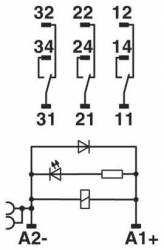
Phoenix Contact 2903294 relay module RIF-3-RPT-LDP-24DC/3X21
| Lieske Part No. | 174176 |
|---|---|
| Mfg Part No | 2903294 |
| EAN-Code | 4046356732710 |
| Manufacturer | Phoenix Contact |
| Here only | 114,95 EUR
136,79 EUR incl. VAT
|
Further information for Phoenix Contact 2903294 relay module RIF-3-RPT-LDP-24DC/3X21
| General | |
| Contact type | 3 changeover contacts |
| Input voltage | 24 V DC |
| Connection system | Push-in |
| Module type | pre-assembled relay module |
| Components | relay socket, power contact relay, retaining bracket |
| Mounting method | in 35-mm rails |
Applications
The relay module is used in electrical circuits where galvanic isolation between control and load circuits is required. It is used for switching loads such as motors, heaters, lamps, or other consumers that need to be activated or deactivated via a control signal. The 3-changeover contact configuration enables the parallel control of multiple circuits with a single relay, allowing the switching system to be designed compactly and efficiently. Typical applications include industrial controls, safety functions, plant monitoring, and communication networks in manufacturing technology.
Functions and Equipment in Detail
The module features a push-in connection, enabling quick and secure wiring without additional tools. The contact configuration with 3 changeovers provides three independent switching points, each offering a contact for the closed and one for the open state. This allows for flexible switching configurations, e.g., for controlling multiple loads or implementing feedback circuits.
Technology Explained Simply
The relay module operates using electromechanical switching technology: when the operating voltage of 24 V DC is applied, an electromagnet is activated, causing the contacts to switch according to the specified changeover configuration. The galvanic isolation between control and load circuits protects the control electronics from disturbances and overvoltages originating from the load side. The use of a relay socket allows for easy replacement of the relay in case of failure, without having to rewire the entire circuit. The integrated retaining bracket ensures secure fixation in the enclosure and prevents the module from falling out.
Compatibility and Accessories
The module is designed for mounting on standard 35 mm rails, enabling universal use in various enclosure systems. As accessories, various markings for terminals are available, such as UCT-TM 5, UC-TM 16, ZB 5, or ZB 15, which serve to clearly identify the connections. Insulating sleeves in various colors (e.g., gray, red, black, white, yellow) as well as jumper bridges (FBS 2-6) can be used to better structure the circuit. End clamps such as CLIPFIX 35 or CLIPFIX 35-5 are used for secure fixation of the rail in the enclosure. Test plugs (MPS-MT) enable easy diagnosis of switching functions.
Mounting and Installation
Installation is done by simply inserting the module into the 35 mm rail holder. Cables are connected using push-in technology, where the connection is secured by pressure and mechanical locking. No additional tools are required. Positioning in the enclosure must follow the circuit diagram specifications, ensuring correct assignment of power supply and load connections. Installation is quick and does not require special skills, as the module is pre-assembled.
Advantages in Operation
The relay module offers high operational reliability due to galvanic isolation and robust mechanical design. The push-in technology reduces installation time and minimizes wiring errors. The 3-changeover configuration enables flexible use in complex circuits. The pre-assembled design ensures quick commissioning, as no additional mounting or wiring steps are required. Compatibility with standard rails and accessories facilitates integration into existing systems.

This is an offer of:
79279 Vörstetten
https://industry-electronics.com
Tel. 07666/88499-0
Fax. 07666/88499-111
Diesen Artikel finden Sie unter:
industry-electronics.com/artikel/174176

Lieske Elektronik e.K.
Reutener Str. 1079279 Vörstetten
https://industry-electronics.com
Tel. 07666/88499-0
Fax. 07666/88499-111
Diesen Artikel finden Sie unter:
industry-electronics.com/artikel/174176