
Phoenix Contact 2902323 D-SUB bus connector SUBCON-PLUS-CAN/90/M12
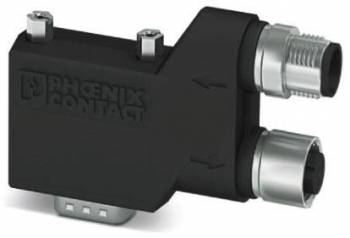
Phoenix Contact 2902323 D-SUB bus connector SUBCON-PLUS-CAN/90/M12
| Lieske Part No. | 1128291 |
|---|---|
| Mfg Part No | 2902323 |
| EAN-Code | 4046356655033 |
| Manufacturer | Phoenix Contact |
| Here only | 44,19 EUR
52,59 EUR incl. VAT
|
Further information for Phoenix Contact 2902323 D-SUB bus connector SUBCON-PLUS-CAN/90/M12
| General | |
| Plug type | D-SUB |
| Number of contacts | 9 |
| Assignment | 2, 3, 5, 7, 9 |
| Cable entry | two M12 |
| Cable entry angle | 90° |
| M12 coding | A-coded |
| Bus system | CAN, CANopen® |
| Terminal resistor | Via separate M12 terminator |
Applications
This connector is used in industrial automation systems where CAN or CANopen® bus systems are employed for communication between controllers, sensors, actuators, and other field devices. It is particularly suitable for applications in manufacturing automation, machine building, and process control, where stable, interference-free data transmission is required. The 90° arrangement of the cable entries is ideal for mounting on devices with limited space, such as control housings or the rear of machine components.
Functions and Features in Detail
The connector features a socket construction with 9 contacts, with pin assignment limited to positions 2, 3, 5, 7, and 9. This assignment corresponds to standards for CAN bus connections, with contacts designated for data lines CAN_H and CAN_L, as well as for ground and power supply lines. The two M12 cable entries enable connection to M12 connectors, which are widely used in industrial electronics. The A-coding of the M12 connectors ensures a secure and error-free connection, as only matching connectors can be inserted.
Technology Explained Simply
The use of M12 connectors provides high mechanical stability and resistance to vibrations and shock loads. The 90° arrangement of the cable entries reduces mechanical stress on the connector, as pulling forces act parallel to the mounting surface. The D-SUB connector form is an established industrial standard, ensuring a secure and tight connection. The integrated pin assignment for CAN and CANopen® systems allows direct integration into existing bus structures without requiring additional adapters or conversion devices.
Compatibility and Accessories
The connector is designed for CAN and CANopen® bus systems and can be connected to compatible M12 connectors. Various bus system cables are available as accessories, including models with different lengths and connectors, such as SAC-5P-MS/ 5,0-920/FS, SAC-5P-MS/ 0,3-920/FS, SAC-5P-MS/ 1,0-920/FS, and SAC-5P-MS/ 2,0-920. For termination resistors in the CAN bus, a separate M12 terminator (e.g., SAC-5P-M12MS CAN TR) is required and must be connected to the M12 connector. These terminators ensure correct impedance matching at the bus end and prevent signal reflections.
Mounting and Installation
Installation is performed by mounting into suitable housings or control panels. The 90° arrangement of the cable entries allows efficient space utilization and simplifies cable routing. The connector is designed for secure mechanical fastening, with the M12 connectors providing high tensile strength. Installation does not require special tools, but clean and orderly cabling is necessary to avoid interference.
Operational Advantages
The connector provides reliable and interference-free data transmission in industrial environments. The combination of D-SUB connector form and M12 cable entry integrates the advantages of both technologies: the mechanical robustness of the M12 connection and the established standardization of the D-SUB form. The A-coding of the M12 connectors reduces the risk of incorrect connections. The 90° arrangement of the cable entries improves ease of installation and reduces mechanical stress on the connection.

This is an offer of:
79279 Vörstetten
https://industry-electronics.com
Tel. 07666/88499-0
Fax. 07666/88499-111
Diesen Artikel finden Sie unter:
industry-electronics.com/artikel/1128291

Lieske Elektronik e.K.
Reutener Str. 1079279 Vörstetten
https://industry-electronics.com
Tel. 07666/88499-0
Fax. 07666/88499-111
Diesen Artikel finden Sie unter:
industry-electronics.com/artikel/1128291