
Phoenix Contact 2799322 fiber cable PSM-LWL-GDM-RUGGED- 50/125
Networks > Fiber and Components
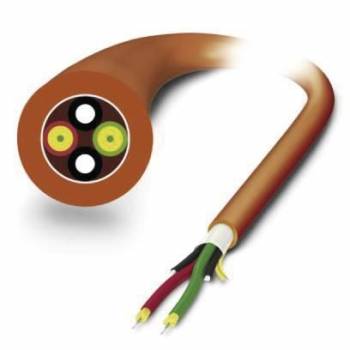
Phoenix Contact 2799322 fiber cable PSM-LWL-GDM-RUGGED- 50/125
| Lieske Part No. | 1773863 |
|---|---|
| Mfg Part No | 2799322 |
| EAN-Code | 4017918074029 |
| Manufacturer | Phoenix Contact |
| Here only | 8,90 EUR
10,59 EUR incl. VAT
|
Further information for Phoenix Contact 2799322 fiber cable PSM-LWL-GDM-RUGGED- 50/125
| General | |
| Cable type | Fiber optic cable |
| Configuration | duplex |
| Core diameter | 50 µm |
| Sheath diameter | 125 µm |
| Delivery unit | meter goods |
| Connector | None |
| Application range | Stationary plants and machines |
| Construction type | RUGGED |
Fibre optic cable with the configuration 50/125 µm is typically suitable for multimode applications in industrial networking. The term “duplex” means that the cable contains two individual fibre optic conductors, each transmitting data in opposite directions, which is necessary for bidirectional communication. The designation RUGGED indicates enhanced mechanical durability, qualifying the cable for use in industrial environments with higher demands for mechanical stability and longevity.
Applications include especially cabling in production plants, automation systems, machine building, and other stationary industrial facilities where high data rates and low susceptibility to interference are required. The cable is supplied without connectors, so it can be individually cut to length at the installation site and subsequently fitted with appropriate connectors. This allows flexible adaptation to specific installation conditions.
Functions and features in detail include the use of multimode fibre optic with a core diameter of 50 µm and a cladding diameter of 125 µm. This specification is widely used in industrial networking and enables efficient data transmission over medium distances. The robust construction of the cable protects the sensitive fibre optic conductors from mechanical stresses such as pressure, tension, and bending, which can occur in industrial environments.
Technology explained simply means that the cable transmits light signals through fibre optic conductors, enabling higher data rates and lower interference compared to conventional copper cables. The multimode technology uses multiple light paths within the fibre, allowing higher bandwidth, although with limited range compared to singlemode systems. The term LWL cable stands for optical fibre cable, a common term in electrical engineering and IT infrastructure for fibre optic cables.
The cable type is designed for use in stationary installations, where the specific choice of connectors (e.g. LC, SC, ST) depends on the network topology and connected devices. The cables are not pre-fitted with connectors, so installation and connection at the endpoints are carried out by the installer.
Installation and mounting require cutting the cable to the desired length and then mounting connectors. Installation takes place in stationary plants, where the cable’s mechanical robustness enables safe installation even in environments with increased mechanical stress. Cabling is typically done in cable ducts, shafts, or through cable protection conduits, depending on the requirements of the specific installation.
Operational advantages include high data transmission rates, low susceptibility to interference, and long service life of the cable. The robust construction ensures long-term durability even under industrial conditions. The meter goods format allows customised installation, avoiding material waste and enabling efficient installation.
Connectors are not included in the delivery scope.

This is an offer of:
79279 Vörstetten
https://industry-electronics.com
Tel. 07666/88499-0
Fax. 07666/88499-111
Diesen Artikel finden Sie unter:
industry-electronics.com/artikel/1773863

Lieske Elektronik e.K.
Reutener Str. 1079279 Vörstetten
https://industry-electronics.com
Tel. 07666/88499-0
Fax. 07666/88499-111
Diesen Artikel finden Sie unter:
industry-electronics.com/artikel/1773863