
Phoenix Contact 1859218 printed circuit board connector UMSTBVK 2,5/ 6-STF-5,08
Industrial Material > Industrial Connectors > Industrial Connectors
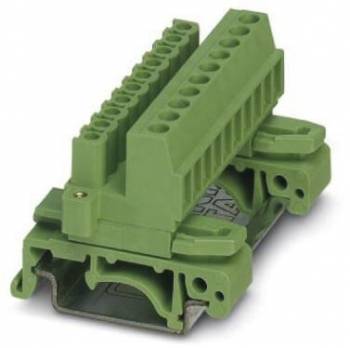
Phoenix Contact 1859218 printed circuit board connector UMSTBVK 2,5/ 6-STF-5,08
| Lieske Part No. | 100682 |
|---|---|
| Mfg Part No | 1859218 |
| EAN-Code | 4017918106270 |
| Manufacturer | Phoenix Contact |
| Here only | 837,62 EUR
996,77 EUR incl. VAT
|
Further information for Phoenix Contact 1859218 printed circuit board connector UMSTBVK 2,5/ 6-STF-5,08
| General | |
| Nominal cross section | 2,5 mm² |
| Colour | Green |
| Nominal current | 12 A |
| Rated voltage (III/2) | 320 V |
| Contact surface | Sn |
| Contact type | Bus |
| Number of potentials | 6 |
| Number of rows | 1 |
| Number of poles | 6 |
| Number of connections | 6 |
| Product family | UMSTBVK 2,5/..-STF |
| Modular spacing | 5,08 mm |
| Connection type | Screw connection with strain relief |
| Screw drive type | L slot |
| Mounting | DIN rail mounting |
| Connection direction wire/PCB | 0 ° |
| Connector system | COMBICON MSTB 2,5 |
| Locking | Screw locking |
| Mounting type | Flange with screws |
| Packaging type | packed in carton |
Applications
The connector is suitable for use in industrial electrical installations, particularly in control and enclosure systems, where a firm and pull-resistant connection is required. Mounting is done on a rail track, enabling quick and standardized installation in existing enclosures. The green color of the housing serves as optical identification and facilitates recognition within the system. The connection direction of 0 ° means that the printed circuit board is connected perpendicular to the rail track, which is typical for vertical mounting configurations.
Functions and Features in Detail
The connector features 6 potentials in a single row, with each connection made via a screw connection with strain relief sleeve. The strain relief sleeve ensures that the cable cannot be pulled out of the contact during connection, increasing the reliability of the connection. The screw drive type is a long slot (L), which can be operated with a standard screwdriver. Locking is achieved via a screw locking mechanism, ensuring a secure and durable connection between plug and socket. Mounting to the housing is done via a screw flange, enabling installation on the rail track.
Technology Explained Simply
The connector is designed for a nominal cross-section of 2.5 mm², allowing a maximum current rating of 12 A. The rated voltage (III/2) is 320 V, making it suitable for applications in industrial electrical engineering. The contact surface is coated with tin (Sn), providing good electrical conductivity and corrosion protection. The contact type is a socket, designed to accept plugs or sockets within the COMBICON system. The pitch of 5.08 mm corresponds to the standard for modular connectors and allows combination with other components of the same system.
Compatibility and Accessories
The connector is part of the COMBICON MSTB 2,5 system and can be combined with matching socket inserts and plugs. Available accessories include, for example, the coding profile CP-MSTB for individual identification of connections, the insert bridge EBP 2-5 for electrical connection of two terminals, and the screwdriver SZS 0,6x3,5 for installation. These components allow flexible adaptation to specific requirements in enclosure construction.
Mounting and Installation
Mounting is done by securing the connector to a standard rail track using the integrated screw flange. The connection direction of 0 ° means that the printed circuit board is connected perpendicular to the rail track. Locking is achieved via screw locking, ensuring a secure and durable connection.
Advantages in Operation
The connector provides a robust and reliable connection designed for industrial use. The use of strain relief sleeves and screw locking ensures high mechanical stability. The modular design of the COMBICON system allows flexible expansion and maintenance of the installation. Clear identification via color and the use of standard pitches simplify planning and installation.

This is an offer of:
79279 Vörstetten
https://industry-electronics.com
Tel. 07666/88499-0
Fax. 07666/88499-111
Diesen Artikel finden Sie unter:
industry-electronics.com/artikel/100682

Lieske Elektronik e.K.
Reutener Str. 1079279 Vörstetten
https://industry-electronics.com
Tel. 07666/88499-0
Fax. 07666/88499-111
Diesen Artikel finden Sie unter:
industry-electronics.com/artikel/100682