
Phoenix Contact 1853023 printed circuit board connector TMSTBP 2,5/ 3-ST-5,08
Industrial Material > Industrial Connectors > Industrial Connectors
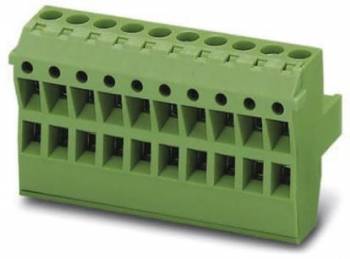
Phoenix Contact 1853023 printed circuit board connector TMSTBP 2,5/ 3-ST-5,08
| Lieske Part No. | 100400 |
|---|---|
| Mfg Part No | 1853023 |
| EAN-Code | 4017918109226 |
| Manufacturer | Phoenix Contact |
| Here only | 864,26 EUR
1.028,47 EUR incl. VAT
|
Further information for Phoenix Contact 1853023 printed circuit board connector TMSTBP 2,5/ 3-ST-5,08
| General | |
| Nominal cross section | 2,5 mm² |
| Colour | Green |
| Nominal current | 12 A |
| Rated voltage (III/2) | 320 V |
| Contact surface | Sn |
| Contact type | Bus |
| Number of potentials | 3 |
| Number of rows | 1 |
| Number of poles | 3 |
| Number of connections | 6 |
| Product family | TMSTBP 2,5/..-ST |
| Modular spacing | 5,08 mm |
| Connection type | Screw connection with strain relief |
| Screw drive type | L slot |
| Connection direction wire/PCB | 0 ° |
| Latching hook | - Latching hooks |
| Connector system | COMBICON MSTB 2,5 |
| Locking | None |
| Mounting type | None |
| Packaging type | packed in carton |
Applications
The connector is designed for use in industrial electrical installations, particularly in control systems, automation systems, and devices where a secure and durable connection between modules is required. The ability to loop wires from module to module makes it especially suitable for compact and modular system architectures. The rated voltage of 320 V (III/2) and the nominal current of 12 A define the application range within medium power levels, typical for control and drive technology.
Functions and Equipment in Detail
The connector features three potentials, with a total of six connections. The contact type is a socket equipped with a strain sleeve to ensure a secure connection during installation. The connection method is via a screw connection with a longitudinal slot (screw engagement form L), enabling a mechanically stable fixation of the wires. The connection direction to the printed circuit board is 0 °, meaning the connections are oriented perpendicular to the board. The contact surface is made of tin (Sn), ensuring good electrical conductivity and corrosion resistance.
Technology Explained Simply
The pitch of 5.08 mm corresponds to a standard spacing used in many industrial connector systems to ensure compatibility with other components. The number of rows is one, indicating a simple, single-row arrangement of contacts. The locking mechanism is not present, meaning the connector is not mechanically secured and relies on the precision fit of the connector system. The mounting method is also not present, so the connector is mounted directly onto the printed circuit board without additional fastening elements.
Compatibility and Accessories
The connector is compatible with the COMBICON MSTB 2.5 connector system. As accessories, insert bridges are available, including the 3-pole EBP 3- 5 (article number 1733172) and the 2-pole EBP 2- 5 (article number 1733169), which are used to connect multiple contacts within the connector. Additionally, a screwdriver SZS 0.6x3.5 (article number 1205053) is available as a tool for installation. These accessories allow flexible adaptation of electrical connections according to requirements.
Mounting and Installation
Installation is performed by direct mounting onto the printed circuit board. The strain sleeve ensures that wires are not pulled out of the contact during tightening. The screw connection requires a screwdriver with a longitudinal slot, which secures the wires firmly. The 0 ° connection direction means the contacts are oriented perpendicular to the board, enabling a compact installation.
Advantages in Operation
The connector enables a reliable and durable electrical connection designed for industrial applications. The ability to loop wires from module to module reduces the number of required connections and simplifies the system architecture. The use of tin as the contact surface ensures good electrical conductivity and resistance to oxidation. Compatibility with the COMBICON MSTB 2.5 system allows easy integration into existing systems.

This is an offer of:
79279 Vörstetten
https://industry-electronics.com
Tel. 07666/88499-0
Fax. 07666/88499-111
Diesen Artikel finden Sie unter:
industry-electronics.com/artikel/100400

Lieske Elektronik e.K.
Reutener Str. 1079279 Vörstetten
https://industry-electronics.com
Tel. 07666/88499-0
Fax. 07666/88499-111
Diesen Artikel finden Sie unter:
industry-electronics.com/artikel/100400