
Phoenix Contact 1441008 SACC-M 8MS-3QO-0,25-M Sensor-Actuator Connector
Industrial Material > Automation > Industrial bus systems
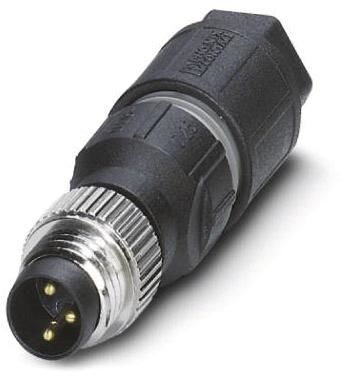
Phoenix Contact 1441008 SACC-M 8MS-3QO-0,25-M Sensor-Actuator Connector
| Lieske Part No. | 146919 |
|---|---|
| Mfg Part No | 1441008 |
| EAN-Code | 4046356515894 |
| Manufacturer | Phoenix Contact |
| Here only | 13,25 EUR
15,77 EUR incl. VAT
|
Further information for Phoenix Contact 1441008 SACC-M 8MS-3QO-0,25-M Sensor-Actuator Connector
| General | |
| Product type | Sensor/actuator connectors |
| Plug connection | M8 |
| Plug type | straight plug |
| Number of poles | 3 |
| Encoding | A |
| Connection system | Insulation displacement connection |
| Knurled material | Zinc die-cast |
| Surface treatment | Nickel-plated |
| Cable outer diameter | 2.5 to 5 mm |
Applications
This connector is designed for use in industrial environments, particularly in automation technology, where robust and reliable connections are required. It is suitable for applications in manufacturing automation, machine building, and process control, where sensor and actuator cables are connected to controls or bus systems. Use in fieldbus technology is typical, with the M8 connector being a standard format for compact and robust connections.
Functions and Equipment in Detail
The connector features a cutting clamp connection, enabling quick and secure cable connection without requiring additional tools such as crimping or soldering. The clamp cuts through the cable insulation and connects the conductor directly, ensuring a reliable electrical connection. The knurled material is made of zinc die-cast, with a nickel-plated surface to prevent corrosion and ensure high mechanical stability. Coding A ensures unique assignment and prevents incorrect connections during installation.
Technology Explained Simply
The M8 connector is a common format in industry, widely used due to its compact design and high mechanical strength. The straight plug allows direct connection in devices and controls. The 3-pole configuration covers most standard applications requiring two conductors for power supply and one conductor for signal or data channel. The cutting clamp reduces installation time and minimizes error sources, as no additional tools or connection techniques are required.
Compatibility and Accessories
The connector is compatible with standard M8 connectors and can be connected to matching sockets. Various tools and adapters are available as accessories to facilitate installation. These include torque screwdrivers such as the TSD 02 SAC or TSD-M 1,2NM, ensuring precise and secure tightening. Additionally, adapter inserts like the TSD-M SAC-BIT ADAPTER and plug caps like the SAC BIT M8-D10 are available, simplifying installation and maintenance. For protection of the connector when connections are not in use, the cap PROT-M 8 FS-PA-CHAIN is available. The sensor/actuator cable SAC-3P-100,0-PUR/0,25 is also available and matches the cable size of the connector.
Installation and Mounting
Installation is performed by inserting the cable into the cutting clamp and securing it via the knurled connection. The clamp cuts the insulation and securely connects the conductor. Tightening is done with a torque screwdriver to ensure the specified torque strength. The connection is mechanically stable and electrically reliable after installation. Using appropriate tools and accessories ensures a professional and error-free installation.
Advantages in Operation
The connector offers high reliability and longevity due to its robust construction from zinc die-cast and nickel-plated surface. The cutting clamp enables fast and secure installation, reducing installation time. Coding A prevents incorrect connections, enhancing operational safety. Use in industrial environments is ensured by the mechanical stability and corrosion resistance of the materials. Compatibility with standard M8 systems and the wide range of accessories simplify integration into existing systems.

This is an offer of:
79279 Vörstetten
https://industry-electronics.com
Tel. 07666/88499-0
Fax. 07666/88499-111
Diesen Artikel finden Sie unter:
industry-electronics.com/artikel/146919

Lieske Elektronik e.K.
Reutener Str. 1079279 Vörstetten
https://industry-electronics.com
Tel. 07666/88499-0
Fax. 07666/88499-111
Diesen Artikel finden Sie unter:
industry-electronics.com/artikel/146919