
Phoenix Contact 1186133 PTI 2,5-PE/L/N-D-R-CLM protective earth terminal
Installation > Home Automation > TEBIS TS
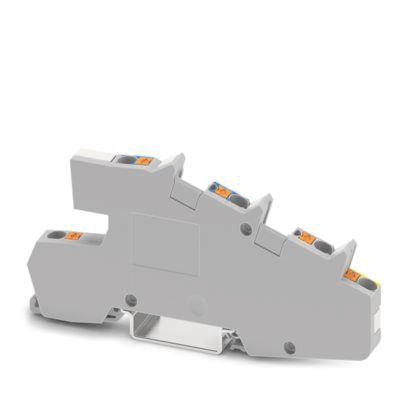
Phoenix Contact 1186133 PTI 2,5-PE/L/N-D-R-CLM protective earth terminal
| Lieske Part No. | 897096 |
|---|---|
| Mfg Part No | 1186133 |
| EAN-Code | 4063151226367 |
| Manufacturer | Phoenix Contact |
| Here only | 3.172,21 EUR
3.774,93 EUR incl. VAT
|
Further information for Phoenix Contact 1186133 PTI 2,5-PE/L/N-D-R-CLM protective earth terminal
| General | |
| Nominal voltage | 400 V |
| Nominal current | 24 A |
| Rated cross-sectional area | 2,5 mm² |
| Cross section | 0,14 - 4 mm² |
| Mounting method | NS 35/7,5, NS 35/15 |
| Colour | Grey |
| Connection system | Push-in connection |
| Floors | 1st, 2nd and 3rd |
Applications
The terminal is used in home automation and industrial electrical installations where safe earthing of electrical devices and systems is necessary. It is suitable for applications in enclosures, distributors, and control systems, particularly in systems using a neutral busbar. Mounting is possible in rows 1, 2, and 3, allowing flexible positioning within the rail. The terminal is rated for a nominal voltage of 400 V and a nominal current of 24 A, making it suitable for typical low-voltage installations in the field of home and building automation.
Functions and Features in Detail
The terminal features a push-in connection that allows for quick and secure connection of conductors with a cross-section from 0.14 mm² to 4 mm². The rated cross-section is 2.5 mm², indicating the maximum conductor thickness for which the terminal is optimized. The grey color of the terminal corresponds to the standard design of Phoenix Contact and enables a uniform visual appearance of enclosures. The terminal is designed for mounting on NS 35/7,5 and NS 35/15 rails, ensuring universal use in standard enclosure environments.
Technology Explained Simply
The push-in connection works by inserting the conductor into a special opening, where it is automatically secured by a spring-loaded contact. This eliminates the need for screwdrivers and reduces installation time. The terminal is rated for a maximum voltage of 400 V and a current of 24 A, which is sufficient for most low-voltage applications in the field of home automation. The use of support bolts at the beginning and end of each terminal rail, as well as every 20 cm for longer rails, is required to securely fix the neutral busbar and ensure mechanical stability.
Compatibility and Accessories
The terminal is compatible with standard rail types NS 35/7,5 and NS 35/15, which are widely used in electrical installations. It can be used in combination with other terminals and switching devices in enclosures, especially in systems using a neutral busbar. The terminal is designed for mounting in rows 1, 2, and 3, allowing flexible positioning within the rail.
Mounting and Installation
Mounting is done on NS 35/7,5 or NS 35/15 rails. For secure fixation of the neutral busbar, support bolts must be installed at the beginning and end of each terminal rail, as well as every 20 cm for longer rails. The terminal is inserted into the rail and locks automatically. The conductor connection is made by inserting it into the push-in connection, with no additional tools required. The installation is tool-free and enables quick and secure assembly.
Operational Advantages
The terminal provides a reliable and durable connection of protective conductors, increasing the safety of the electrical installation. The push-in connection reduces installation time and minimizes error susceptibility. The use of support bolts ensures mechanical stability of the neutral busbar, increasing the longevity of the installation. The terminal is rated for a nominal voltage of 400 V and a nominal current of 24 A, making it suitable for typical applications in home automation. The grey color supports a uniform visual appearance of enclosures.

This is an offer of:
79279 Vörstetten
https://industry-electronics.com
Tel. 07666/88499-0
Fax. 07666/88499-111
Diesen Artikel finden Sie unter:
industry-electronics.com/artikel/897096

Lieske Elektronik e.K.
Reutener Str. 1079279 Vörstetten
https://industry-electronics.com
Tel. 07666/88499-0
Fax. 07666/88499-111
Diesen Artikel finden Sie unter:
industry-electronics.com/artikel/897096