
Patlite LA6-5DTNWB-POE Signal Tower POE
Industrial Material > Control devices / Pilot devices > Signal devices, optical and acoustic
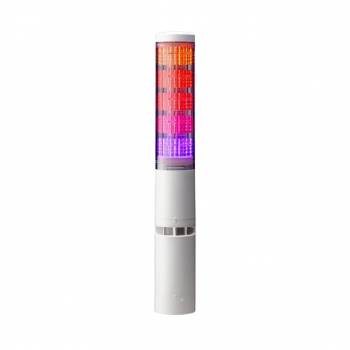
Patlite LA6-5DTNWB-POE Signal Tower POE
| Lieske Part No. | 1635376 |
|---|---|
| Mfg Part No | LA6-5DTNWB-POE |
| EAN-Code | 4938766018037 |
| Manufacturer | Patlite |
| Here only | 632,28 EUR
752,41 EUR incl. VAT
|
Further information for Patlite LA6-5DTNWB-POE Signal Tower POE
| General | |
| Degree of protection | IP54 |
| Operating voltage | Direct current, PoE |
| Operation temperature | -10 to 50 °C |
| Storage temperature | 0 to 90 °C |
| Lamp type | LED |
| Form factor | Round |
| Position | Indoor |
| Diffuser colour | Multicolour |
| Product colour | White |
| Protocols | Modbus TCP/IP, HTTP |
| LED colours | 21 programmable |
| Alarms | 11 selectable |
| Control options | Web interface, terminal block |
| Certification | RoHS |
Applications
The signal tower is suitable for applications in the manufacturing industry, machine control, logistics environments, or production lines where clear, coloured, and acoustic feedback on operational status is required. The programmable LED colours and alarm functions allow individual assignment of signals to specific events, such as status messages, warnings, or fault conditions. The mirroring function enables signal replication from a master signal tower to multiple slave devices, supporting signal synchronisation across multiple locations.
Functions and Equipment in Detail
The device features 21 programmable LED colours, which can be configured according to application requirements. Additionally, 11 different alarm tones are available, which can also be set via the web interface. Control is possible either via the integrated network protocol (Modbus TCP/IP, HTTP) or via an integrated terminal block, enabling an alternative, cable-based control method. The signal tower is finished in white and has a round form factor with a width of 60 mm.
Technology Explained Simply
PoE technology (Power over Ethernet) enables power supply and data transmission over a single Ethernet cable, simplifying installation and reducing the number of required cables. Support for Modbus TCP/IP and HTTP allows integration into existing network infrastructures and control systems. The web interface provides a user-friendly interface for configuring signals, colours, and alarm functions. The signal tower is designed for operation at temperatures from -10 to 50 °C, making it suitable for typical industrial environments.
Compatibility and Accessories
The signal tower is designed for use in networks with PoE support. Compatibility with Modbus TCP/IP and HTTP enables connection to various control systems and SCADA platforms. The mirroring function allows synchronisation with additional signal towers, ensuring consistent signalling across multiple locations. The signal tower is intended for indoor use and complies with protection class IP54, which means protection against dust and splashing water.
Mounting and Installation
Installation is performed via an Ethernet cable, which simultaneously provides power supply and data transmission. The signal tower can be mounted at a suitable location indoors, provided environmental conditions (temperature, humidity) remain within the specified limits. Configuration is done via the web interface, accessible through a web browser. Control can be performed via the network or via the integrated terminal block.
Advantages in Operation
The combination of PoE technology and a web interface reduces installation costs and simplifies maintenance. Programmable LED colours and alarm tones allow flexible adaptation to specific requirements. The mirroring function supports signal synchronisation in larger installations. The signal tower is robustly constructed and designed for industrial environments, with protection class IP54 providing sufficient protection against dust and splashing water. The operating temperature range of -10 to 50 °C covers most industrial operating conditions.

This is an offer of:
79279 Vörstetten
https://industry-electronics.com
Tel. 07666/88499-0
Fax. 07666/88499-111
Diesen Artikel finden Sie unter:
industry-electronics.com/artikel/1635376

Lieske Elektronik e.K.
Reutener Str. 1079279 Vörstetten
https://industry-electronics.com
Tel. 07666/88499-0
Fax. 07666/88499-111
Diesen Artikel finden Sie unter:
industry-electronics.com/artikel/1635376