
Moxa ICF-1150I-M-SC media converter
Networks > Industrial Networking > Media Converters
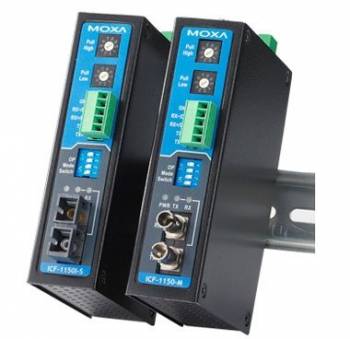
Moxa ICF-1150I-M-SC media converter
| Lieske Part No. | 601856 |
|---|---|
| Mfg Part No | ICF-1150I-M-SC |
| EAN-Code | |
| Manufacturer | Moxa |
| Here only | 389,00 EUR
462,91 EUR incl. VAT
|
Further information for Moxa ICF-1150I-M-SC media converter
| General | |
| Number of serial ports | 2 |
| IP protection class | IP30 |
| Air humidity | 5–95 % (nicht kondensierend) |
| Safety approval | UL 61010-2-201 |
Applications
This converter is suitable for industrial communication applications where serial devices must be connected over long distances using fiber optic cables. Typical use cases include connecting PLCs, sensors, controls, or industrial terminals to a fiber optic network. Support for RS-485 in 2- and 4-wire technology, along with automatic data direction control (ADDC), simplifies integration into existing systems, especially in RS-485 networks where data direction often changes dynamically. The galvanic isolation of 2 kV protects sensitive devices from voltage spikes and potential differences.
Functions and Features in Detail
The device features two serial ports connected via a 5-pin terminal block. Supported serial standards include RS-232, RS-422, and RS-485 in 2- and 4-wire configurations. The baud rate can be set between 50 bps and 921.6 kbps, including non-standard values. Data direction control is handled automatically via ADDC, simplifying configuration for RS-485 applications. For RS-485, various resistance combinations can be set using DIP switches, including Pull High/Low resistors in values from 150 kΩ to 485 Ω, and terminator resistors of 120 Ω and 120 kΩ. Signal assignment is clearly defined for all standards: RS-232 uses TxD, RxD, and GND; RS-422 uses Tx+, Tx-, Rx+, Rx-, and GND; RS-485 uses Data+, Data-, and GND.
Technology Explained Simply
The galvanic isolation of 2 kV electrically separates the serial interfaces from the fiber optic network, protecting against voltage spikes and electromagnetic interference. This safeguards connected devices and enhances communication stability. Automatic data direction control (ADDC) detects data direction in the RS-485 network automatically, eliminating the need to manually set direction via DIP switches or software. Power supply is provided via a terminal block with voltage ranging from 12 to 48 VDC, and the converter includes reverse polarity protection and overcurrent protection. Maximum power consumption is 300 mA.
Compatibility and Accessories
The converter is designed for use with multimode fiber optic cables with SC connector. Compatibility with various RS-485 resistance combinations allows adaptation to different network topologies. The serial interfaces are universally applicable and support common industrial protocols.
Mounting and Installation
The device is delivered in a robust metal housing and is designed for mounting on a DIN rail. The IP protection class IP30 protects against contact with foreign objects and splashing water, but not against direct water jets or dust. Dimensions are 30.3 mm (width) × 70 mm (height) × 115 mm (depth), and weight is 330 g. Mounting is simple by clipping into a DIN rail, with power supply via the terminal block.
Operational Advantages
The ICF-1150I-M-SC offers high operational reliability through galvanic isolation and EMC approvals. Automatic data direction control reduces configuration complexity, especially in RS-485 networks. Support for a wide power supply range of 12 to 48 VDC increases installation flexibility. Certifications according to UL 61010-2-201, IEC 61000-4-2 to -4-8, CISPR 32, and FCC Part 15B Class A ensure high electromagnetic compatibility and safety. Explosion protection certification according to UL/cUL Class I Div. 2 Groups A/B/C/D and ATEX Zone 2 allows use in potentially explosive environments. The MTBF is 792,085 hours according to Telcordia standard, indicating high reliability. Warranty is 5 years.
Operating Environment
The device is designed for operation at temperatures from 0 to 60 °C. Storage temperature ranges from -40 to 85 °C. Relative humidity may range from 5 to 95 %, with condensation excluded. Environmental tests according to IEC 60068-2-1/-2/-3 and vibration tests according to IEC 60068-2-6 ensure functionality under industrial conditions.
Certifications and Standards
The converter meets EMC requirements according to EN 55032/35, CISPR 32, and FCC Part 15B Class A. Electromagnetic compatibility is certified according to IEC 61000-4-2 to -4-8. Safety certification is according to UL 61010-2-201. Explosion protection certification according to UL/cUL Class I Div. 2 Groups A/B/C/D and ATEX Zone 2 allows use in hazardous areas. Environmental tests according to IEC 60068-2-1/-2/-3 and vibration tests according to IEC 60068-2-6 confirm the robustness of the device.
Mechanical and Electrical Properties
The housing is made of metal and designed for mounting on a DIN rail. The IP protection class IP30 provides protection against contact with foreign objects and splashing water. Power supply is via a terminal block with 12 to 48 VDC, including integrated reverse polarity and overcurrent protection. Maximum power consumption is 300 mA. Dimensions are 30.3 mm × 70 mm × 115 mm, and weight is 330 g.

This is an offer of:
79279 Vörstetten
https://industry-electronics.com
Tel. 07666/88499-0
Fax. 07666/88499-111
Diesen Artikel finden Sie unter:
industry-electronics.com/artikel/601856

Lieske Elektronik e.K.
Reutener Str. 1079279 Vörstetten
https://industry-electronics.com
Tel. 07666/88499-0
Fax. 07666/88499-111
Diesen Artikel finden Sie unter:
industry-electronics.com/artikel/601856