
Moxa CSM-200-1218 media converter 10/100BaseT(X) to 100BaseFX
Networks > Industrial Networking > Media Converters
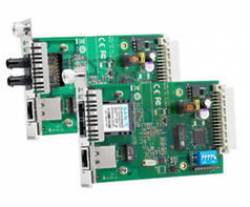
Moxa CSM-200-1218 media converter 10/100BaseT(X) to 100BaseFX
| Lieske Part No. | 176157 |
|---|---|
| Mfg Part No | CSM-200-1218 |
| EAN-Code | |
| Manufacturer | Moxa |
| Here only | 376,00 EUR
447,44 EUR incl. VAT
|
Further information for Moxa CSM-200-1218 media converter 10/100BaseT(X) to 100BaseFX
| General | |
| Ethernet interface | 10/100BaseT(X) RJ45 |
| Fibre optic interface | 100BaseFX Singlemode, SC connector |
| Operating modes | Store-and-Forward, Pass-Through |
| Fault detection | Link Fault Pass-Through (LFP), Far End Fault (FEF) |
| Insulation | 1,5 kV magnetically integrated |
| Compatibility | Only for Moxa NRack System™ |
| Hot-swap capable | |
| Plug-and-Play | |
| Auto-negotiation | |
Applications
The CSM-200-1218 is designed for industrial networks where reliable and secure data transmission over long distances is required. It is particularly suitable for applications in manufacturing, energy supply, transportation, or the networking of distributed systems, where fiber optic is advantageous due to its high bandwidth, low susceptibility to interference, and long reach. Use within the NRack System™ enables modular expansion of network infrastructures, allowing the module to be seamlessly integrated into existing enclosures.
Functions and Features in Detail
The device features an RJ45 connector for copper Ethernet connection, supporting auto-negotiation to automatically detect transmission speed (10 or 100 Mbit/s) and duplex modes (half- or full-duplex). On the fiber optic side, the CSM-200-1218 provides an SC connector for singlemode fiber optic, enabling transmission over longer distances compared to multimode connections. The integrated magnetic isolation of 1.5 kV protects the device and the connected network from transient voltage spikes, which is especially important in industrial environments with strong electromagnetic interference.
Technology Explained Simply
The functions Link Fault Pass-Through (LFP) and Far End Fault (FEF) enable proactive fault detection. In the event of a connection failure on the copper or fiber optic side, this is immediately passed on to the connected device, allowing network management systems or monitoring solutions to react quickly. The two operating modes – Store-and-Forward and Pass-Through – offer flexibility: In Store-and-Forward mode, the entire data packet is checked before forwarding, increasing data integrity. In Pass-Through mode, forwarding occurs without checking, enabling lower latency. The choice of mode depends on specific network performance requirements.
Compatibility and Accessories
The CSM-200-1218 is exclusively intended for use in the Moxa NRack System™. It is not compatible with other enclosures or systems. Use with other modules of the CSM-200 series, such as variants with multimode fiber optic or ST connector, is also possible within the NRack System, but selection requires consideration of the respective fiber type (singlemode vs. multimode) and connector type (SC vs. ST).
Mounting and Installation
Mounting is done by simply inserting the module into the NRack enclosure. The hot-swap capability allows replacement without switching off power or the network, ensuring operational continuity. The plug-and-play function ensures no additional configuration is required – the device automatically detects network settings.
Operational Advantages
Through the combination of hot-swap capability, integrated isolation, and proactive fault detection, the CSM-200-1218 offers high network availability. The use of singlemode fiber optic enables efficient data transmission over long distances, with the low susceptibility to interference of fiber optic ensuring signal quality over the entire distance. The modular design in the NRack System supports a flexible and scalable network architecture that can adapt to growing requirements.

This is an offer of:
79279 Vörstetten
https://industry-electronics.com
Tel. 07666/88499-0
Fax. 07666/88499-111
Diesen Artikel finden Sie unter:
industry-electronics.com/artikel/176157

Lieske Elektronik e.K.
Reutener Str. 1079279 Vörstetten
https://industry-electronics.com
Tel. 07666/88499-0
Fax. 07666/88499-111
Diesen Artikel finden Sie unter:
industry-electronics.com/artikel/176157