
Mitsubishi 46788 brake resistor external 230 V 0.4 kW
Industrial Material > Engines and accessories
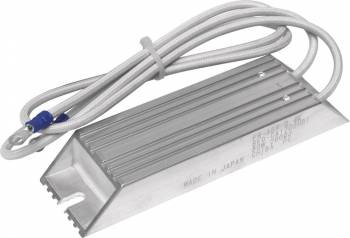
Mitsubishi 46788 brake resistor external 230 V 0.4 kW
| Lieske Part No. | 657942 |
|---|---|
| Mfg Part No | 46788 |
| EAN-Code | |
| Manufacturer | Mitsubishi |
| Here only | 29,26 EUR
34,82 EUR incl. VAT
|
Further information for Mitsubishi 46788 brake resistor external 230 V 0.4 kW
| General | |
| Operating voltage | 230 V |
| Nominal power | 0,4 kW |
| Resistance value | 200 Ohm |
| Effective duration | 10 % ED |
| Manufacturer | Mitsubishi |
Applications
The brake resistor is used in drive systems where mechanical energy is converted back into electrical energy during braking or when loads are moving downward. This energy can overload the DC-link of the frequency converter if not dissipated. The FR-ABR-0,4 K ensures that the energy is released in the form of heat, maintaining the stability of the converter. Typical applications include conveyor systems, lifting and hoisting equipment, and machines with intermittent braking operations, where high thermal load capacity is required.
Functions and Features in Detail
The resistor has a rated power of 0.4 kW and is designed for an operating voltage of 230 V. The resistance value is 200 Ohm, allowing precise adjustment of the braking characteristics. The thermal load capacity is specified at 10 % ED (duty cycle), meaning the resistor is designed for operation with 10 % load duration per cycle. This corresponds to typical use in intermittent operating conditions, where the resistor is not continuously loaded. The construction is designed for industrial environments, with mechanical stability and heat dissipation ensured by the design.
Technology Explained Simply
An external brake resistor such as the FR-ABR-0,4 K is required when the integrated brake resistor of a frequency converter is insufficient or when higher thermal load capacity is needed. During regenerative braking, energy is fed back into the DC-link, which can cause voltage overloads. The brake resistor activates in these cases and dissipates the excess energy by converting it into heat. The resistance value of 200 Ohm influences the braking strength — a higher resistance results in lower current draw and thus weaker braking effect. The operating voltage of 230 V is standard for most industrial facilities and allows easy integration into existing power supply systems.
Compatibility and Accessories
The brake resistor is designed for use with Mitsubishi frequency converters, particularly models that support external braking functions. Exact compatibility depends on the specific converter model series, with electrical parameters (voltage, power, resistance) being critical. Installation typically takes place at a suitable location in the machine room, requiring sufficient ventilation and spacing from other components to ensure effective heat dissipation.
Installation typically takes place at a suitable location in the machine room, requiring sufficient ventilation and spacing from other components to ensure effective heat dissipation.
Operational Advantages
Using the FR-ABR-0,4 K enables reliable and controlled braking in drive systems, thereby extending the service life of the frequency converter and connected machinery. The low rated power of 0.4 kW makes it particularly suitable for smaller drives where high thermal load is not required. Simple installation and clear electrical specifications facilitate integration into existing systems. The thermal load capacity of 10 % ED is sufficient for many industrial applications, especially when braking operations are not continuous. The construction is robust and designed for industrial environments, with heat dissipation optimized by the design.

This is an offer of:
79279 Vörstetten
https://industry-electronics.com
Tel. 07666/88499-0
Fax. 07666/88499-111
Diesen Artikel finden Sie unter:
industry-electronics.com/artikel/657942

Lieske Elektronik e.K.
Reutener Str. 1079279 Vörstetten
https://industry-electronics.com
Tel. 07666/88499-0
Fax. 07666/88499-111
Diesen Artikel finden Sie unter:
industry-electronics.com/artikel/657942