
MICROSENS MS100213D SFP GbE transceiver 1.25 Gbit/s EX SingleMode 1550 nm 50 km DDM LC
Networks > Switches > Modules
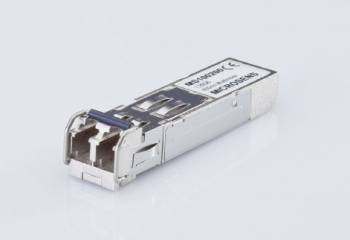
MICROSENS MS100213D SFP GbE transceiver 1.25 Gbit/s EX SingleMode 1550 nm 50 km DDM LC
| Lieske Part No. | 1120312 |
|---|---|
| Mfg Part No | MS100213D |
| EAN-Code | |
| Manufacturer | MICROSENS |
| Here only | 203,77 EUR
242,49 EUR incl. VAT
|
Further information for MICROSENS MS100213D SFP GbE transceiver 1.25 Gbit/s EX SingleMode 1550 nm 50 km DDM LC
| Technical data | |
| GBIC application site | Standard |
| GBIC compatibility | uncoded |
| Technology | LC fibre optic LWL |
| SFP | SFP |
| Speed Mini-GBIC | 1000Mbit |
| Mode | Singlemode LX |
| Distance | 50km |
SFP-Pluggable-Transceiver is the general term for small, hot-swappable modules used in network devices to provide optical or electrical interfaces. The MICROSENS module is designed as SFP (Small Form-factor Pluggable), enabling a compact form factor and simplifying integration into devices with limited space. The term Gigabit Ethernet refers to the network technology with a bandwidth of 1000 Mbit/s, widely used in modern LAN and WAN environments. Additionally, the module supports Gigabit Fibre Channel, a technology primarily used in storage networks (SAN) to ensure high data rates with low latency.
Singlemode-LWL (long-wavelength optical fiber) is a type of fiber optic cable optimized for transmitting light signals over long distances. Unlike multimode fibers, which transmit multiple light modes simultaneously, singlemode fiber uses only one light mode, resulting in lower signal loss and higher bandwidth over long distances. The wavelength of 1550 nm is particularly efficient in the singlemode range, as it exhibits low attenuation in fiber optic cables. The reach of at least 50 km makes the module suitable for applications in long-distance connections, such as between branches or in backbone networks. The use of a DFB-laser (Distributed Feedback Laser) ensures stable and precise light emission, which is critical for reliable data transmission over long distances.
LC-connector is a standard for fiber optic connectors, widely used in modern networks due to its compact design and high precision. The LC connector enables a secure and reliable optical connection between the transceiver and the fiber optic cable. The Digital Diagnostics Monitoring (DDM) function allows real-time monitoring of the module’s operating data. This includes parameters such as module temperature, supply voltage, transmit power (Tx Power), and receive power (Rx Power). These data can be queried via the network device to monitor operation and detect potential issues early.
The module is designed for use in standard networks, with compatibility specified as uncoded. This means it does not require specific manufacturer or system codes, making it usable in a wide range of devices with an SFP slot. The technology LC fiber optic LWL is an integral part of the specification and describes the type of optical interface. The speed of 1000 Mbit/s corresponds to the Gigabit-Ethernet standard and enables high data rates for use in modern network infrastructures. The distance of 50 km is an important specification that defines the module’s application possibilities in extensive networks.
Installation is performed by simply inserting the module into an SFP slot of the network device. No tools are required, and the module can be replaced during operation (hot-swappable), simplifying network maintenance and configuration. The use of DDM enables proactive network monitoring, allowing failures or performance drops to be detected early.
Operational advantages lie in the combination of high reach, compact design, and integrated diagnostic function. The ability to transmit data over 50 km without requiring additional amplifiers reduces the complexity and cost of network infrastructure. The DDM function supports network administration in troubleshooting and maintenance by providing real-time data on the module’s operating status. Compatibility with Gigabit-Ethernet and Gigabit-Fibre-Channel expands the module’s application possibilities in various network environments.

This is an offer of:
79279 Vörstetten
https://industry-electronics.com
Tel. 07666/88499-0
Fax. 07666/88499-111
Diesen Artikel finden Sie unter:
industry-electronics.com/artikel/1120312

Lieske Elektronik e.K.
Reutener Str. 1079279 Vörstetten
https://industry-electronics.com
Tel. 07666/88499-0
Fax. 07666/88499-111
Diesen Artikel finden Sie unter:
industry-electronics.com/artikel/1120312