
Metz Connect 151J1JOAO20E Patch Cable LC-D/2xST OM3 2m
Cables > Data lines > Cat6 Patch Cable
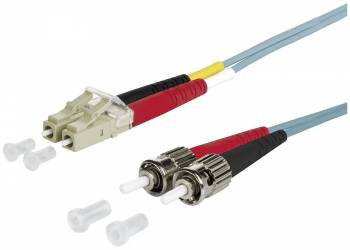
Metz Connect 151J1JOAO20E Patch Cable LC-D/2xST OM3 2m
| Lieske Part No. | 205475 |
|---|---|
| Mfg Part No | 151J1JOAO20E |
| EAN-Code | 4250184147978 |
| Manufacturer | Metz Connect |
| Here only | 15,23 EUR
18,13 EUR incl. VAT
|
Further information for Metz Connect 151J1JOAO20E Patch Cable LC-D/2xST OM3 2m
| General | |
| Fibre type | multimode OM3 |
| Core diameter | 50 µm |
| Sheath diameter | 125 µm |
| Fibre standard | IEC 60793-2-10 Type A1a.3 |
| Cable type | Duplex cable |
| Cable construction | Zipcord (figure 8) |
| Tension relief | Aramid |
| Material outer sheath | halogen-free, low smoke emission LSHF-FR |
| Outer diameter | 2,0 x 4,2 mm |
| Test | 100 % tested |
| Flame retardancy | |
| Laser-optimised | |
| Bend-insensitive | |
Applications
This patch cable is designed for use in modern network infrastructures, particularly in environments requiring high data rates and short transmission distances, such as data centres, server rooms, or for connecting switches, routers, and other network devices. The OM3 fibre enables data transmission at up to 10 Gbit/s over distances of up to 300 metres, depending on the network topology. The bend-insensitive design makes the cable especially suitable for installations where the cable is frequently bent or installed in confined spaces without impairing optical performance.
Functions and Equipment in Detail
The cable is designed as a duplex cable, meaning two fibres are laid in parallel to enable bidirectional data transmission. The use of aramid fibres as tensile strength members protects the sensitive glass fibre conductors from mechanical stress, especially during cabling and when connecting to connectors. The jacket materials are halogen-free (LSHF-FR) and exhibit low smoke emission, reducing fire load and minimizing smoke development in case of fire. The flame-retardant property increases safety during use, especially in enclosed spaces. The cable is constructed as a zipcord (figure 8), enabling compact and flexible installation.
Technology Explained Simply
The cable's fibre is designed as a multimode fibre of category OM3, meaning it is designed for transmitting light signals with multiple modes (light waves). The laser-optimized design enables higher bandwidth and longer transmission distances compared to conventional multimode fibres. The bend-insensitive construction protects the fibre from microcracks that could result from frequent bending. The aramid tensile strength members evenly distribute tensile forces along the cable, protecting the fibres from mechanical damage. The jacket materials are specifically developed for use in enclosed spaces to avoid releasing toxic gases in case of fire.
Compatibility and Accessories
The patch cable is designed for use with standard connectors such as LC and ST, with the exact connector type varying depending on configuration. The cable configurator function allows adjustment of length and connectors to meet individual requirements. The cables are designed for use in networks with 10 Gbit/s and higher, with actual bandwidth depending on the network topology and devices used. The OM3 fibre is compatible with all devices specified for multimode fibres of category OM3.
Installation and Mounting
Installation of the patch cable is performed by connecting the connectors to the respective network devices. The bend-insensitive construction allows flexible routing, even in confined spaces. The tensile strength provided by aramid fibres protects the fibres from mechanical stress, especially during cabling and connection. The flame-retardant and halogen-free jacket materials meet fire safety requirements in server rooms and data centres.
Operational Advantages
The patch cable provides reliable and stable data transmission at high speeds. The bend-insensitive design and tensile strength provided by aramid fibres increase the cable's lifespan and reduce the likelihood of errors due to mechanical stress. The halogen-free and flame-retardant jacket materials increase safety during use, especially in enclosed spaces. The 100 % testing ensures the quality and performance of the cable.

This is an offer of:
79279 Vörstetten
https://industry-electronics.com
Tel. 07666/88499-0
Fax. 07666/88499-111
Diesen Artikel finden Sie unter:
industry-electronics.com/artikel/205475

Lieske Elektronik e.K.
Reutener Str. 1079279 Vörstetten
https://industry-electronics.com
Tel. 07666/88499-0
Fax. 07666/88499-111
Diesen Artikel finden Sie unter:
industry-electronics.com/artikel/205475