
Metz Connect 150N1JO0020E Pigtail LC-PC OM4
Networks > Fiber and Components
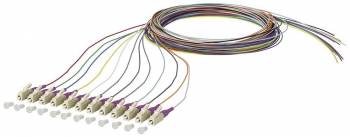
Metz Connect 150N1JO0020E Pigtail LC-PC OM4
| Lieske Part No. | 313736 |
|---|---|
| Mfg Part No | 150N1JO0020E |
| EAN-Code | 4250184153078 |
| Manufacturer | Metz Connect |
| Here only | 63,36 EUR
75,40 EUR incl. VAT
|
Further information for Metz Connect 150N1JO0020E Pigtail LC-PC OM4
| General | |
| Connector | LC |
| Plug connection | single-sided mounted |
| Fibre type | multimode fibre OM4 |
| Fibre diameter | 50/125 µm |
| Fibre class | G50/125 |
| Bend insensitivity | compliant with IEC 60793-2-10 Type A1a.3 |
| Cable type | Pigtail |
| Cable diameter | 0,9 mm |
| Cable length | 2,0 m |
| Colour sequence | according to IEC 60304: red, green, blue, yellow, white, grey, brown, violet, turquoise, black, orange, pink |
| Secondary and primary coating | uniformly coloured |
| Insertion loss | 100 % tested |
| Return loss | 100 % tested |
| Connector standard | IEC 61754-20 |
Applications
The pigtail is typically used in fibre cable connection technology, for example, when connecting switches, routers, or other network devices to fibre cable infrastructures. The use of OM4 multimode fibre enables data transmission rates up to 10 Gbit/s over distances of up to 550 metres, making it suitable for applications in data centres, corporate networks, and structured cabling systems. The colour sequence according to IEC 60304 (red, green, blue, yellow, white, grey, brown, violet, turquoise, black, orange, pink) supports the clear identification of individual fibres in the cable set, which is beneficial during installation and maintenance.
Functions and equipment in detail
The cable features an LC connector according to IEC 61754-20, ensuring precise and secure connection. The connector is mounted on one side only, making the cable function as a pigtail — i.e., equipped with a connector at only one end. The fibre has a diameter of 50/125 µm (G50/12ed) and is classified as multimode fibre OM4, ensuring high bandwidth and low attenuation at high data rates. The compact conductor has a diameter of 0.9 mm, enabling compact and flexible cable routing. The secondary and primary coating are the same colour, simplifying optical identification of the fibre.
Technology explained simply
The designation OM4 refers to a multimode fibre class optimised for high data rates and long transmission distances. The fibre is bend-insensitive, meaning it does not exhibit significant signal loss even under tight bends — a key advantage during installation in confined spaces or when routing in cable ducts. The insertion loss and return loss have been 100 % tested, confirming the quality and reliability of the product. A test report is included, documenting the measured values and thus verifying compliance with technical specifications.
Compatibility and accessories
The pigtail is compatible with all devices supporting an LC connector. It can be combined with suitable crimp splice protection elements available in variants 15090401-E (12 pcs) and 15090401-I (150 pcs). These protective caps provide mechanical protection for the splice and prevent fibre damage. Combining the pigtail with these accessories is recommended when installing in a splice box or any environment subject to mechanical stress.
Installation and mounting
Installation is performed by directly inserting the LC connector into the corresponding device. Cable routing is simple and flexible due to the small diameter of the compact conductor (0.9 mm) and the bend-insensitive fibre. The one-sided mounting of the connector requires no additional tools or special mounting procedures. The colour marking of the fibres simplifies assignment and cabling, especially in complex networks.
Advantages in operation
Using this pigtail ensures reliable and stable data transmission at high speeds. The bend-insensitive fibre reduces the risk of signal loss due to mechanical stress. The complete testing of optical parameters (insertion loss, return loss) and the delivery with a test report increase transparency and quality assurance. The uniform colouring of primary and secondary coating, along with the standardised colour sequence according to IEC 60304, supports error-free and efficient installation and maintenance.

This is an offer of:
79279 Vörstetten
https://industry-electronics.com
Tel. 07666/88499-0
Fax. 07666/88499-111
Diesen Artikel finden Sie unter:
industry-electronics.com/artikel/313736

Lieske Elektronik e.K.
Reutener Str. 1079279 Vörstetten
https://industry-electronics.com
Tel. 07666/88499-0
Fax. 07666/88499-111
Diesen Artikel finden Sie unter:
industry-electronics.com/artikel/313736