
Metz Connect 1308451044-E Patch Cable Cat6A blue
Cables > Data lines > Cat6 Patch Cable
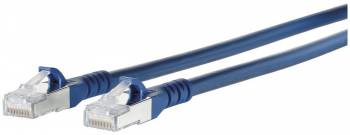
Metz Connect 1308451044-E Patch Cable Cat6A blue
| Lieske Part No. | 284739 |
|---|---|
| Mfg Part No | 1308451044-E |
| EAN-Code | 4250184117452 |
| Manufacturer | Metz Connect |
| Here only | 5,77 EUR
6,86 EUR incl. VAT
|
Further information for Metz Connect 1308451044-E Patch Cable Cat6A blue
| General | |
| Degree of protection | fully shielded |
| Cable category | Cat.6A |
| Wire gauge | AWG 26/7 |
| Bandwidth | 500 MHz |
| Certification | GHMT PVP |
| Connection | RJ45 |
| Plug wiring | 1-1 |
| Bend protection | Moulded sleeve with latch protection |
| Material | LaBS-free, halogen-free |
| Compatibility | 10 GBit Ethernet (IEEE 802.3an), PoE, PoE plus, UPoE, HDBaseT |
| Norm | ISO/IEC 11801 Ed.2.2: 2011-06, DIN EN 50173-1: 2011-09 |
| Colour | Blue |
Applications
This patch cable is specifically designed for unshielded and shielded Class E, A systems. It is used in networks requiring high data rates, such as in office buildings, server rooms, or for connecting switches, routers, end devices, and network sockets. Support for 10 GBit Ethernet (IEEE 802.3an) makes it suitable for modern, high-performance networks. It is also intended for remote powering (PoE, PoE plus, and UPoE) as well as HDBaseT applications, enabling power supply to IP cameras, access points, or other PoE-capable devices.
Functions and Equipment in Detail
The cable features two shielded RJ45 connectors with wiring 1-1, ensuring a direct, non-crossed connection. The connectors are equipped with a molded strain relief boot that provides an integrated latch lock protection. This prevents accidental disconnection and protects the connectors from mechanical stress. The identical width of the strain relief boot and the RJ45 connector ensures a uniform and stable connection. The cable is LaBS-free and halogen-free, increasing safety during use, especially in enclosed spaces.
Technology Explained Simply
The fully shielded design (S/FTP) protects the internal conductors from electromagnetic interference and prevents signal radiation, thereby enhancing signal integrity. Category Cat.6A enables a bandwidth up to 500 MHz, ensuring stable and fast data transmission. The AWG 26/7 structure indicates the wire gauge and the number of wires per conductor, ensuring good conductivity and low signal loss. Certification according to GHMT PVP guarantees compliance with quality standards for network cables.
Compatibility and Accessories
The cable is suitable for use in systems according to ISO/IEC 11801 Ed.2.2: 2011-06 and DIN EN 50173-1: 2011-09. It can be combined with other patch cables from the same series, such as variants with lengths of 0.5 m, 1.5 m, 2 m, or 3 m, also available in blue. Color variants include black, white, gray, red, blue, yellow, green, orange-black, violet-black, and purple-black, enabling visual differentiation in complex networks. The packaging unit is 1 piece in poly bag (ending -E) or 10 pieces in poly bag (ending -Z), with the exact variant created via the configurator.
Installation and Mounting
Installation is performed by simply inserting the RJ45 connectors into the corresponding sockets of switches, routers, end devices, or network sockets. The strain relief boot and latch lock protection facilitate handling and ensure a secure connection. No special tools are required, as the connectors snap in directly. Cable extension is achieved by connecting multiple cables, ensuring the total length does not exceed the maximum allowable length for the desired transmission rate.
Operational Advantages
The cable offers high signal stability and low error susceptibility due to its fully shielded construction. Support for PoE and HDBaseT expands application possibilities, especially for transmitting power and data over a single cable. The halogen-free and LaBS-free design increases safety in case of fire. The robust construction with strain relief boot ensures long service life even under frequent mechanical stress. Color coding simplifies identification and maintenance in the network.

This is an offer of:
79279 Vörstetten
https://industry-electronics.com
Tel. 07666/88499-0
Fax. 07666/88499-111
Diesen Artikel finden Sie unter:
industry-electronics.com/artikel/284739

Lieske Elektronik e.K.
Reutener Str. 1079279 Vörstetten
https://industry-electronics.com
Tel. 07666/88499-0
Fax. 07666/88499-111
Diesen Artikel finden Sie unter:
industry-electronics.com/artikel/284739