
Metz Connect 1108311319 Modbus RTU 10 digital inputs
Industrial Material > Automation > Industrial bus systems
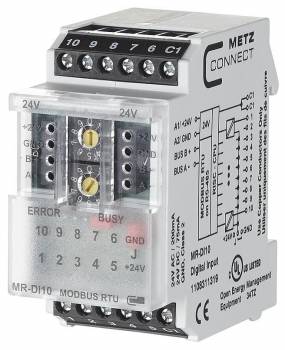
Metz Connect 1108311319 Modbus RTU 10 digital inputs
| Lieske Part No. | 960060 |
|---|---|
| Mfg Part No | 1108311319 |
| EAN-Code | 4250184135609 |
| Manufacturer | Metz Connect |
| Here only | 124,10 EUR
147,67 EUR incl. VAT
|
Further information for Metz Connect 1108311319 Modbus RTU 10 digital inputs
| General | |
| Number of digital inputs | 10 |
| Protocol | Modbus RTU |
| Mounting method | TH35 mounting rail |
| Connection type | Screw terminals |
| Addressing | via 2 address switches or software |
| Norm | IEC 60715 |
Applications
The module is intended for decentralized mounting in electrical distribution boards and is particularly suitable for applications in building automation, production control, or energy distribution, where reliable acquisition of switching states is required. The decentralized installation allows for flexible positioning of the inputs at the respective location of the sensor or switch, thereby optimizing cabling and clearly structuring the system architecture.
Functions and equipment in detail
The 10 digital inputs can be operated both as contact inputs and as voltage inputs, enabling adaptation to different sensor types. The status information of the inputs is transmitted to a Modbus master via the Modbus-RTU protocol, with data being queried via standard registers. The module addressing, bit rate setting, and parity can be configured either via two address switches on the front panel or through software configuration. This provides flexibility for integration into existing systems and simplifies parameterization.
Technology explained simply
The module uses the Modbus-RTU protocol, a widely used serial communication protocol in industry, designed for data transmission between a master and multiple slaves via RS-485 interfaces. The inputs are designed to detect both potential-free contacts (e.g., from relays or limit switches) and voltage signals (e.g., 24 V DC). Communication takes place via a serial interface connected through the designated screw terminals. Configuration via front panel switches allows for simple, tool-free setting of the module address and communication parameters.
Compatibility and accessories
The module is designed for mounting on a TH35 support rail according to IEC 60715, ensuring standardization in electrical installations. It is therefore compatible with a wide range of enclosures and distributors that use this support rail. Connections are made via screw terminals, ensuring a secure and mechanically stable connection. Communication is via RS-485, enabling connection to other Modbus-RTU devices and a Modbus master.
Mounting and installation
Mounting is done on a TH35 support rail, which is standard in electrical distribution boards and enclosures. The front panel of the module features two address switches for setting the module address, which must be configured according to the network plan during commissioning.
Advantages in operation
Decentralized mounting allows direct proximity to the sensor, improving signal quality and reducing cabling length. Support for both contact and voltage inputs increases flexibility when integrating various sensors. Configuration via front panel switches or software offers adjustment options without additional tools. Use of the Modbus-RTU protocol ensures broad compatibility with existing systems and controls.

This is an offer of:
79279 Vörstetten
https://industry-electronics.com
Tel. 07666/88499-0
Fax. 07666/88499-111
Diesen Artikel finden Sie unter:
industry-electronics.com/artikel/960060

Lieske Elektronik e.K.
Reutener Str. 1079279 Vörstetten
https://industry-electronics.com
Tel. 07666/88499-0
Fax. 07666/88499-111
Diesen Artikel finden Sie unter:
industry-electronics.com/artikel/960060