
Chauvin Arnoux DOX2100B digital oscilloscope 2x100 MHz
Measurement
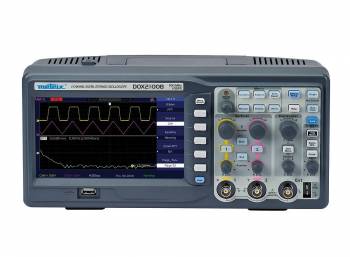
Chauvin Arnoux DOX2100B digital oscilloscope 2x100 MHz
| Lieske Part No. | 1927967 |
|---|---|
| Mfg Part No | DOX2100B |
| EAN-Code | 3663653001489 |
| Manufacturer | Metrix |
| Here only | 1.097,03 EUR
1.305,47 EUR incl. VAT
|
Further information for Chauvin Arnoux DOX2100B digital oscilloscope 2x100 MHz
| General | |
| Sampling rate 1 channel | 1 GS/s |
| Sampling rate ETS mode | 50 GS/s |
Applications
The DOX2100B is designed for use in laboratory environments, electronic circuit development, maintenance and testing of devices, as well as in training. The high bandwidth and detailed signal recording make it particularly suitable for analysing high-frequency signals, digital interfaces, and transient events. The integrated PASS/FAIL function supports quality control by checking signals against predefined envelope curves, enabling quick decisions.
Functions and Equipment in Detail
The oscilloscope offers a maximum sampling rate of 500 MS/s for two channels and 1 GS/s for one channel in Single Shot mode. In ETS mode (Equivalent Time Sampling), it achieves a sampling rate of up to 50 GS/s, enabling detailed analysis of high-frequency signals. Vertical sensitivity ranges from 2 mV/div to 10 V/div, covering a wide range of signal amplitudes. The timebase can be set from 2.5 ns/div to 50 s/div, allowing flexible adaptation to different signal speeds.
Technology Explained Simply
The maximum memory depth of 2 million points ensures that even complex and slow signals can be recorded with high resolution. The 32 automatic measurement functions allow simultaneous display of parameters such as amplitude, frequency, pulse width, and others, enabling quick signal analysis without manual input. Additionally, manual cursor measurements are available to precisely capture specific points in the signal waveform. The 5 MATH functions, including real-time FFT analysis, allow for deeper signal processing, for example, frequency analysis or calculation of signal amplifications.
Compatibility and Accessories
The device features multiple communication interfaces, including USB Host and USB Device, enabling direct connection to a PC. The EASYSCOPE software supports remote control, data backup, and transfer of curve files and screen copies. The software is designed for controlling and evaluating measurement results and extends the oscilloscope’s functionality in laboratory environments. Additional functions such as digital filters, auto-calibration, ROLL mode, and RECORDER mode expand application possibilities and support users in signal processing and documentation.
Mounting and Installation
The DOX2100B is designed as a benchtop instrument and requires no special mounting. It features a foldable handle and non-slip feet to ensure secure placement on the workbench. Operation is via a menu available in five languages, with context help provided in English. Device configuration is performed via the user interface, and connection to a PC is made through the USB interfaces.
Advantages in Operation
The combination of high bandwidth, large memory depth, and diverse analysis functions makes the DOX2100B a powerful tool for professional users. Real-time FFT analysis and PASS/FAIL functions increase efficiency in signal testing. The USB interfaces and EASYSCOPE software enable seamless integration into existing workflows and simplify documentation and further processing of measurement results. The compact design and portability, thanks to the integrated handle, also make it suitable for mobile applications.
Protection Rating and Safety
The device complies with safety standard IEC 61010-1 and is designed for an operating voltage of 300 V CAT II, ensuring safe use in laboratory environments. The construction meets requirements for electrical safety when measuring voltages in electronic devices and circuits.

This is an offer of:
79279 Vörstetten
https://industry-electronics.com
Tel. 07666/88499-0
Fax. 07666/88499-111
Diesen Artikel finden Sie unter:
industry-electronics.com/artikel/1927967

Lieske Elektronik e.K.
Reutener Str. 1079279 Vörstetten
https://industry-electronics.com
Tel. 07666/88499-0
Fax. 07666/88499-111
Diesen Artikel finden Sie unter:
industry-electronics.com/artikel/1927967