
MakeKit Air:bit 2.0 Single Inventor Kit Drone
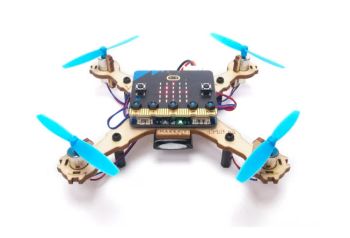
MakeKit Air:bit 2.0 Single Inventor Kit Drone
| Lieske Part No. | 162003 |
|---|---|
| Mfg Part No | Air:bit 2.0 Single |
| EAN-Code | |
| Manufacturer | MakeKit |
| Here only | 114,91 EUR
136,74 EUR incl. VAT
|
Further information for MakeKit Air:bit 2.0 Single Inventor Kit Drone
| General | |
| Product type | micro:bit quadcopter kit |
| Compatibility | micro:bit V1 and V2 |
| Programming | MakeCode Blocks, JavaScript, Python |
| Battery | LiPo |
| Battery capacity | 800 mAh |
| Flight time | 5–7 minutes |
| Number of electric motors | 4 |
| Number of propellers | 8 |
| Frame material | Plywood |
| Accessories | Nylon screws, nuts, spacers, copper cylinder nuts, silicone ring, rubber band, wedges, cardboard accessories |
Applications
The MakeKit Air:bit 2.0 Single is primarily targeted at educational institutions, maker communities, and hobby developers interested in programmable robotic systems. It is suitable for use in computer science, physics, and technology classes, as it illustrates fundamental concepts such as control, sensor technology, and programming logic. The drone can also serve as a base for advanced projects, such as integrating additional sensors or cameras via the micro:bit ecosystem.
Features and Specifications in Detail
The kit includes an Air:bit board that functions as the central control unit and connects to the micro:bit. The board is linked to four electric motors, each driving a propeller. The propellers are arranged in two pairs with opposite rotation directions to ensure stable flight dynamics. Flight control is managed via the micro:bit, which can be operated using the motion sensors of a smartphone, tablet, or another micro:bit. The drone can also be programmed using MakeCode Blocks, JavaScript, or Python, enabling custom flight maneuvers and responses to sensor inputs.
Technology Explained Simply
The Air:bit board acts as an interface between the micro:bit and the flight components. It controls the electric motors and processes inputs from the micro:bit. Flight time is approximately 5 to 7 minutes, depending on battery life. The integrated LiPo battery has a capacity of 800 mAh and powers both the electronics and the motors. The drone is designed for indoor use, with flight stability ensured by the propeller arrangement and micro:bit-based control. The use of plywood as the frame material provides a lightweight yet sturdy construction.
Compatibility and Accessories
The MakeKit Air:bit 2.0 Single is compatible with BBC micro:bit V1 and V2. However, the micro:bit V2 is recommended for operation due to its enhanced sensors and improved processing power. The kit can be expanded with additional components from the micro:bit ecosystem, such as a collision sensor, camera, smart glove, or buzzer. These extensions enable more complex projects, such as object detection or interactive control.
Assembly and Installation
Assembly involves putting together individual components on the plywood frame. This includes mounting the Air:bit board, electric motors, propellers, and battery unit. Components are secured using nylon screws, nuts, spacers, and copper cylinder nuts. A removable plywood holder serves as a mount for the remote control. The assembly instructions are included in the kit, although no specific documentation is mentioned in the text. Wiring is done through the integrated connectors on the Air:bit board.
Advantages in Operation
The MakeKit Air:bit 2.0 Single offers intuitive control via motion sensors and flexible programming options using multiple languages. The combination of physical construction and software development promotes understanding of technical relationships. The use of open standards like MakeCode and Python allows for broad adaptability. The drone is easy to assemble and suitable for educational environments as well as hobby projects.

This is an offer of:
79279 Vörstetten
https://industry-electronics.com
Tel. 07666/88499-0
Fax. 07666/88499-111
Diesen Artikel finden Sie unter:
industry-electronics.com/artikel/162003

Lieske Elektronik e.K.
Reutener Str. 1079279 Vörstetten
https://industry-electronics.com
Tel. 07666/88499-0
Fax. 07666/88499-111
Diesen Artikel finden Sie unter:
industry-electronics.com/artikel/162003