
Lindner B222917 Fuse Insert gG 6A Green
Installation > Securing material > D-Fuses and Accessories
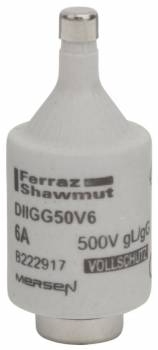
Lindner B222917 Fuse Insert gG 6A Green
| Lieske Part No. | 253304 |
|---|---|
| Mfg Part No | B222917 |
| EAN-Code | 4086500000036 |
| Manufacturer | Lindner |
| Here only | 6,08 EUR
7,24 EUR incl. VAT
|
Further information for Lindner B222917 Fuse Insert gG 6A Green
| General | |
| Fuse type | D-system |
| Size | DII |
| Utilization category | gG |
| Nominal current | 6 A |
| Operating voltage | 500 V |
| Colour | Green |
| Norm | DIN VDE 0636-30 |
Applications
This fuse insert is intended for use in low-voltage installations, particularly in systems where fuses are easily accessible and can be replaced by non-specialized personnel. This makes it especially suitable for industrial, commercial, and some commercial building installations where simple maintenance and replaceability are required. The fuse protects conductors and electrical installations against overloads and short circuits.
Functions and Equipment in Detail
The fuse insert is designed for operating class gG, which provides general protection for electrical installations and devices. It reliably interrupts unauthorized overcurrents and short-circuit currents up to the rated switching current. The green color serves as a visual identifier and is standard within D-fuse systems. The fuse is rated for an operating voltage of 500 V AC, making it suitable for standard low-voltage installations. The rated current is 6 A, indicating the maximum current the fuse can continuously carry without tripping.
Technology Explained Simply
The D-fuse is a mechanical protective device that interrupts the circuit when the permissible current is exceeded, via an internal fuse link. This fuse link is dimensioned so that it does not melt at 6 A, but only at higher currents exceeding the rated load. The operating class gG means the fuse reliably interrupts even at high short-circuit currents and absorbs the electrodynamic forces generated by such currents. The DIN VDE 0636-“30” standard defines the requirements for construction, electrical properties, and testing procedures for these fuse types.
Compatibility and Accessories
The fuse insert is designed for DII size, meaning it can be used in fuse holders and fuse boxes designed for DII dimensions. It is part of the D-fuse system and can therefore be combined with other D-fuses of sizes NDZ, DIII, DIV, and DV, provided the respective holders are compatible. Use in installations already employing D-fuses is straightforward, as mechanical dimensions are standardized.
Mounting and Installation
Installation involves inserting the fuse insert into a suitable D-fuse holder mounted in a fuse box or distribution unit. The screw connection ensures a secure electrical contact. Installation is done by simply screwing it into the holder, ensuring correct alignment and secure seating. The fuse is not intended for use in explosive environments, as no special protective measures for such environments are specified.
Advantages in Operation
The D-fuse provides simple and reliable protection for electrical installations. The ability to replace the fuse by non-specialists reduces maintenance time and dependence on skilled personnel. The operating class gG ensures a high level of protection, especially during short-circuit events. Standardization within the D-fuse system enables easy replaceability and compatibility with existing installations. The green color marking supports quick identification and classification during operation.

This is an offer of:
79279 Vörstetten
https://industry-electronics.com
Tel. 07666/88499-0
Fax. 07666/88499-111
Diesen Artikel finden Sie unter:
industry-electronics.com/artikel/253304

Lieske Elektronik e.K.
Reutener Str. 1079279 Vörstetten
https://industry-electronics.com
Tel. 07666/88499-0
Fax. 07666/88499-111
Diesen Artikel finden Sie unter:
industry-electronics.com/artikel/253304