
Lenovo 4XE1B81919 Cable Lock Double Head
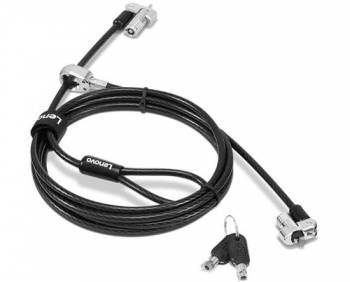
Lenovo 4XE1B81919 Cable Lock Double Head
| Lieske Part No. | 1125500 |
|---|---|
| Mfg Part No | 4XE1B81919 |
| EAN-Code | 0195348792936 |
| Manufacturer | Lenovo |
| Here only | 54,11 EUR
64,39 EUR incl. VAT
|
Further information for Lenovo 4XE1B81919 Cable Lock Double Head
| Features | |
| Product colour | Black |
| Best uses | Laptop |
| Lock type | Key |
| Keys quantity | 2 keys |
| Packaging data | |
| Quantity per pack | 1 pc(s) |
| Package width | 250 mm |
| Package depth | 170 mm |
| Package height | 30 mm |
| Weight & dimensions | |
| Cable length | 1.8 m |
| Cable diameter | 5 mm |
| Weight | 270 g |
Applications
The cable lock is primarily designed for securing laptops, especially in public or shared workspaces such as offices, libraries, schools, or conference rooms. It is also suitable for other mobile devices that feature a Kensington security slot. The lock can be used indoors as well as in protected outdoor areas where physical attachment to a fixed object is possible. The combination of cable and key mechanism offers a simple yet effective protection against unauthorized removal of the device.
Features and Equipment in Detail
The lock includes a key-operated locking mechanism, supplied with two keys. The keys allow opening and closing of the lock, with the provision of two keys adding an extra layer of security, for example in case one key is lost. The cable is flexible and can be wound around objects, enabling secure attachment to various surfaces. The lock’s construction allows for rotational and pivoting movement of the cable, facilitating adaptation to different mounting points. The use of a carbon steel cable ensures high mechanical stability and resistance to sawing or tearing.
Technology Explained Simply
The cable lock operates on the principle of physical fixation: the cable is threaded through the laptop’s security slot and secured to a fixed object. The lock itself is secured using a key, preventing removal of the cable without the key. The technology includes a special locking mechanism known as Cleat Locking Technology, as well as a patented Hidden Pin Technology, which protects against drilling or prying open the lock. The cable is made of carbon steel, ensuring high strength and durability. The cable length of 1.8 m allows for flexible placement, while the 5 mm diameter provides sufficient stability.
Compatibility and Accessories
The lock is compatible with laptops featuring a Kensington security slot. This is a standard connection implemented in many laptop models from various manufacturers. The lock can be used regardless of the laptop brand, as long as the security slot is present. The product is supplied as a single unit, with the packaging indicating 1 piece per pack.
Installation and Mounting
Installation involves inserting the cable into the Kensington security slot of the laptop and securing the other end to a fixed object such as a desk or metal frame. The lock is secured using a key, preventing removal of the cable without the key. The installation requires no tools and can be performed by any user. The flexible design of the cable allows adaptation to various mounting points.
Operational Advantages
The cable lock provides a simple and reliable method for physically securing laptops. The use of two keys increases security and enables redundant access control. The robust carbon steel cable ensures high resistance to mechanical attacks. The cable length of 1.8 m offers sufficient flexibility for securing to various objects. The compact design and low weight of 270 g enable easy handling and storage. The product is specifically designed for use in office environments and public spaces where physical security of IT devices is important.

This is an offer of:
79279 Vörstetten
https://industry-electronics.com
Tel. 07666/88499-0
Fax. 07666/88499-111
Diesen Artikel finden Sie unter:
industry-electronics.com/artikel/1125500

Lieske Elektronik e.K.
Reutener Str. 1079279 Vörstetten
https://industry-electronics.com
Tel. 07666/88499-0
Fax. 07666/88499-111
Diesen Artikel finden Sie unter:
industry-electronics.com/artikel/1125500