
Lenovo INT (4XB7A90879)
Computer-Components > Hard Drives > SSD SATA
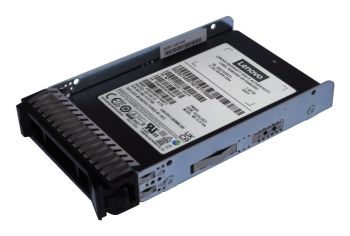
Lenovo INT (4XB7A90879)
| Lieske Part No. | 104700 |
|---|---|
| Mfg Part No | 4XB7A90879 |
| EAN-Code | 0889488712540 |
| Manufacturer | Lenovo |
| Here only | 2.177,00 EUR
2.590,63 EUR incl. VAT
|
Further information for Lenovo INT (4XB7A90879)
| Features | |
| SSD capacity | 480 GB |
| SSD form factor | 3.5" |
| Interface | Serial ATA III |
| Memory type | V-NAND TLC |
| Component for | Server/workstation |
| Data transfer rate | 6 Gbit/s |
| Read speed | 480 MB/s |
| Write speed | 320 MB/s |
| Random read (4KB) | 81000 IOPS |
| Random write (4KB) | 28000 IOPS |
| Uncorrectable Bit Error Rate (UBER) | < 1 per 10^17 bits read |
| Mean time between failures (MTBF) | 2000000 h |
| Drive writes per day (DWPD) | 1 |
| Certification | UL TUV FCC CE Mark C-Tick Mark BSMI (Taiwan) KCC (Korea EMI) |
| NVMe | |
| Hardware encryption | |
| S.M.A.R.T. support | |
| ECC | |
| Hot-swap | |
| H/W PLP function | |
| Operational conditions | |
| Operating temperature (T-T) | 0 - 70 °C |
| Storage temperature (T-T) | -40 - 85 °C |
| Operating relative humidity (H-H) | 5 - 95% |
| Operating shock | 1500 G |
| Non-operating shock | 20 G |
| Maximum operating altitude | 3050 m |
| Other features | |
| Sequential reading | 480 MB/s |
| Sequential writing speed | 460 MB/s |
| Sequential read/write | |
| Weight & dimensions | |
| Width | 70 mm |
| Depth | 100 mm |
| Height | 7 mm |
Applications
This drive is primarily intended for server and workstation systems, where it can be used as a primary or secondary storage resource. The Read Intensive design makes it particularly suitable for applications that involve frequent reading but infrequent writing, such as databases, web servers, or virtual machines. Support for Hot-Swap allows the drive to be replaced during operation, which is advantageous in high-availability environments.
Functions and Features in Detail
The SSD achieves a sequential read speed of 480 MB/s and a write speed of 320 MB/s, ensuring efficient data processing. For random access (4KB), the values are 81,000 IOPS for reading and 28,000 IOPS for writing, indicating good performance with small, fragmented data blocks. Hardware encryption provides high protection for sensitive data, with encryption performed directly within the drive and not dependent on the system level. S.M.A.R.T. support enables monitoring of the drive's condition to detect potential failures early.
Technology Explained Simply
The use of V-NAND TLC memory chip technology means that the memory cells are arranged in a vertical structure, enabling higher density and efficiency. TLC (Triple Level Cell) stores three bits per cell, resulting in higher capacity, although with fewer write cycles compared to MLC or SLC. Hardware encryption is performed via an integrated encryption chip that encrypts data during writing and decrypts it during reading, without requiring CPU or software involvement. The Hot-Swap function allows the drive to be replaced without restarting the system, which is important for critical applications. The H/W PLP function (Hardware Power Loss Protection) protects against data loss in case of sudden power failure by using an internal buffer to complete the last write operations.
Compatibility and Accessories
The drive is designed as a Vendor Agnostic SSD, meaning it is not bound to a specific server manufacturer and can therefore be used in various server platforms. Compatibility with servers and workstations is ensured by the standard SATA III interface and the 8,9 cm ( 3,5 inch ) form factor. It is suitable for use in rack servers and tower systems that have corresponding drive bays.
Mounting and Installation
Installation is performed in a 8,9 cm ( 3,5 inch ) drive bay, with physical dimensions (70 mm width, 100 mm depth, 7 mm height) matching the standard for this form factor. Mounting is done via integrated mounting holes, compatible with standard screws for 8,9 cm ( 3,5 inch ) drives. Power supply is provided via the standard SATA power connector, connected using the SATA power cable.
Operational Advantages
The SSD offers high reliability with an MTBF (Mean Time Between Failures) of 2,000,000 hours, indicating a long service life. The Uncorrectable Bit Error Rate (UBER) is < 1 per 10^17 bits read, ensuring data integrity. The operating temperature of 0 to 70 °C and storage temperature of -40 to 85 °C make the drive suitable for a wide range of environments. The shock resistance of 1500 G during operation and 20 G when not in operation ensures high mechanical robustness. The certifications UL, TUV, FCC, CE Mark, C-Tick Mark, BSMI (Taiwan), KCC (Korea EMI) confirm compliance with international safety and emission standards.

This is an offer of:
79279 Vörstetten
https://industry-electronics.com
Tel. 07666/88499-0
Fax. 07666/88499-111
Diesen Artikel finden Sie unter:
industry-electronics.com/artikel/104700

Lieske Elektronik e.K.
Reutener Str. 1079279 Vörstetten
https://industry-electronics.com
Tel. 07666/88499-0
Fax. 07666/88499-111
Diesen Artikel finden Sie unter:
industry-electronics.com/artikel/104700