
ifm Electronic PP003E pressure sensor 0...25 bar G 1/4 external IO-Link
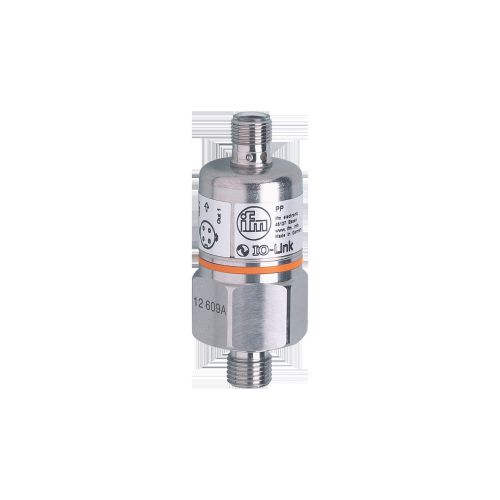
ifm Electronic PP003E pressure sensor 0...25 bar G 1/4 external IO-Link
| Lieske Part No. | 505957 |
|---|---|
| Mfg Part No | PP003E |
| EAN-Code | 4021179244381 |
| Manufacturer | Ifm Electronic |
| Here only | 293,23 EUR
348,94 EUR incl. VAT
|
Further information for ifm Electronic PP003E pressure sensor 0...25 bar G 1/4 external IO-Link
| Accuracy / Deviations | |
| Switching point accuracy | < ± 0.5 % of span |
| Repeatability | < ± 0.1; (with temperature variations < 10 K) % of span |
| Characteristic deviation | < ± 0.25 (BFSL) / < ± 0.5 (LS); (BFSL = Best Fit Straight Line (minimum setting); LS = end-point setting) % of span |
| Neutral point stabilisation | Switch output, indication / 1.0 % of span |
| Hysteresis deviation | < ± 0.1 % of span |
| Long-term stability | < ± 0.1; (per year) % of span |
| Temperature coefficient zero point | < ± 0.2; (0...80 °C) % of span / 10 K |
| Temperature coefficient range | < ± 0.2; (0...80 °C) % of span / 10 K |
| Approvals / tests | |
| EMC | Electromagnetic compatibility / EN 61000-6-2; EN 61000-4-2 ESD / 4 kV contact discharge / 15 kV air discharge; EN 61000-4-3 RF radiated / 20 V/m; EN 61000-4-4 Burst / 4 kV coupling clamp; EN 61000-4-5 Surge / 0.5 kV supply / 1 kV signal for DC devices; EN 61000-4-6 RF conducted / 10 V; Electromagnetic compatibility / ECE R 10, Rev. 5; Absorber chamber test according to ISO 11452-2: / 80 V/m |
| Shock resistance | DIN IEC 60068-2-27 / DIN IEC 60068-2-29 / 1000 g; DIN EN 61373 / Category 3 |
| Vibration resistance | DIN IEC 68-2-6 / 20 g (10...2000 Hz); DIN EN 60068-2-64 / 14 g; DIN EN 61373 / Category 2 |
| MTTF | 310 years |
| Printer directive | Good engineering practice; suitable for fluids of group 2; fluids of group 1 on request |
| Railway applications | DIN EN 50155 / Class T3, C1, S1 |
| Displays / controls | |
| Indication | Operation / 2 x LED, green; Switching state / 2 x LED, yellow |
| Teach function | |
| Electrical connection | |
| Plug connection | 1 x M12; coding: A; contacts: 4 |
| Electrical data | |
| Operating voltage | 9.6...36 DC; (communication operation: 18...32) V |
| Electricity consumption | < 45 mA |
| Minimum insulation resistance | 100; (500 V DC) MΩ |
| Protection class | III |
| Standby delay time | 0,3 s |
| Reverse polarity protection | |
| Environmental conditions | |
| Ambient temperature | -25...85 °C |
| Storage temperature | -40...100 °C |
| Degree of protection | IP 68; (7 days / 1 m water depth / 0.1 bar) |
| Field of application | |
| Application | For railway applications; For mobile use |
| Media | Liquid and gaseous media |
| Medium temperature | -25...90 °C |
| Min. bursting pressure | 350 bar / 5075 psi / 35 MPa |
| Compressive strength | 150 bar / 2175 psi / 15 MPa |
| Pressure type | Gauge pressure |
| Interfaces | |
| Communication interface | IO-Link |
| Transmission type | COM2 (38.4 kBaud) |
| IO-Link revision | 1.0 |
| Required master port class | A |
| Analog process data | 1 |
| Process data binary | 2 |
| Min. process cycle time | 2,3 ms |
| Supported DeviceIDs | Operation mode / DeviceID; default / 5 |
| SIO mode | |
| Measurement / adjustment range | |
| Switching point SP | 0.2...25 bar / 4...362 psi / 0.02...2.5 MPa |
| Reverse switch point rP | 0.1...24.9 bar / 2...360 psi / 0.01...2.49 MPa |
| In steps of | 0.1 bar / 2 psi / 0.01 MPa |
| Factory setting | SP1 = 6.3 bar / rP1 = 5.8 bar; SP2 = 18.8 bar / rP2 = 18.3 bar; OUT1 = Hno / OUT2 = Hno |
| Mechanical data | |
| Housing | Cylindrical |
| Dimensions | Ø 30 / L = 79,5 mm |
| Materials | 1.4301 (stainless steel / 304); FKM; EPDM/X; PA |
| Materials in contact with the medium | 1.4305 (stainless steel / 303); ceramic; FKM |
| Min. pressure cycles | 100 million |
| Choke element present | no (retrofit available) |
| Outputs | |
| Total number of outputs | 2 |
| Output signal | Switching signal; IO-Link; (configurable) |
| Electrical version | PNP |
| Number of digital outputs | 2 |
| Output function | Normally open contact (NO) / Normally closed contact (NC); (configurable) |
| Max. voltage drop switching output DC | 2 V |
| Continuous current rating of switching output DC | 250 mA |
| Switching frequency DC | 170 Hz |
| Short-circuit protection type | timed |
| Short-circuit protection | |
| Overload resistant | |
| Product features | |
| Number of inputs and outputs | Number of digital outputs: 2 |
| Measuring range | 0...25 bar / 0...363 psi / 0...2.5 MPa |
| Process connection | Threaded connection G 1/4 male thread; Internal thread: M5 |
| Remarks | |
| Remarks | With respect to UL: “limited voltage” with overcurrent protection according to UL508 |
| Response times | |
| Response time | < 3 ms |
| Attenuation process value dAP steps | 0,003 - 0,006 - 0,010 - 0,017 - 0,060 - 0,125 - 0,250 - 0,500 s |
Applications
The pressure sensor PP003E is specifically designed for mobile applications such as construction machinery, agricultural technology, or railway systems. The high shock and vibration resistance, as well as excellent EMC immunity, make it suitable for demanding environments. The protection rating IP 68 ensures complete dust and water tightness, including immersion resistance at a depth of 1 meter for 7 days at a pressure of 0.1 bar. The ambient temperature can range from -25 °C to 85 °C, while the storage temperature ranges from -40 °C to 100 °C. The minimum burst pressure resistance is 350 bar, and the pressure resistance is 150 bar, ensuring high safety under mechanical stress.
Functions and Equipment in Detail
The sensor features two configurable switching outputs, one of which can be programmed as a diagnostic output. The switching points (SP) can be set in the range of 0.2 to 25 bar, and the reset points (rP) from 0.1 to 24.9 bar, in steps of 0.1 bar. The factory setting is SP1 = 6.3 bar, rP1 = 5.8 bar, and SP2 = 18.8 bar, rP2 = 18.3 bar, with both outputs configured as Hno (high for normally open). The switching point accuracy is less than ±0.5 % of the span, and the repeatability is less than ±0.1 % of the span with temperature fluctuations under 10 K. The characteristic deviation is under ±0.25 % (BFSL) or ±0.5 % (LS) of the span. The zero point stabilization is 1.0 % of the span, the hysteresis deviation is less than ±0.1 % of the span, and the long-term stability is less than ±0.1 % per year. The response time is under 3 ms, and the damping of the process value can be adjusted in eight steps from 0.003 to 0.500 seconds.
Technology Explained Simply
The ceramic sensing cell ensures high accuracy and long-term stability, even under fluctuating temperatures. The temperature coefficients for zero point and span are each under ±0.2 % of the span per 10 K in the range of 0 to 80 °C. The IO-Link interface (COM2, 38.4 kBaud, Revision 1.0) enables bidirectional communication with an IO-Link master, requiring master port class A. The SIO-Mode function supports serial communication. The process data includes an analog value and two binary signals, with a minimum process cycle time of 2.3 ms. Supported DeviceIDs are operating mode/DeviceID default/5. EMC tests include immunity to disturbances according to EN 61000-6-2, ESD (4 kV contact discharge, 15 kV air discharge), HF radiated disturbances (20 V/m), burst (4 kV), surge (0.5 kV supply, 1 kV signal), and HF conducted disturbances (10 V). Additionally, the sensor meets the requirements of ECE R 10, Rev. 5 and the absorber chamber test according to ISO 11452-2 (80 V/m). Shock resistance corresponds to DIN IEC 60068-2-27/29 (1000 g) and DIN EN 61373 (Category 3), vibration resistance to DIN IEC 68-2-6 (20 g, 10–2000 Hz) and DIN EN 61373 (Category 2).
Compatibility and Accessories
The sensor is designed for use with IO-Link masters that support the required master port class A. The plug connection enables easy installation. The materials in contact with the medium consist of stainless steel 1.4305 (303), ceramic, and FKM, ensuring high corrosion resistance. The housing consists of stainless steel 1.4301 (304), FKM, EPDM/X, and PA. A throttling element is not included but can be retrofitted. The display is provided by two green LEDs for operation and two yellow LEDs for switching status. A teach function allows for easy on-site adjustment of switching points.
Mounting and Installation
The process connection is via a G 1/4 external thread, supplemented by an internal thread M5. Mounting is done by direct connection to the process system. The plug connection enables a quick and secure electrical connection. Installation is carried out in an environment that meets the ambient temperature range of -25 to 85 °C and the protection rating IP 68. The minimum pressure cycles amount to 100 million, ensuring a long service life under frequent pressure changes.
Operational Advantages
The sensor offers high reliability through the ceramic sensing cell, high shock and vibration resistance, and the IP 68 protection rating. The IO-Link interface enables easy diagnosis and parameterization via the master. The configurable switching outputs and the teach function facilitate adaptation to specific applications. The high EMC immunity and compliance with railway application standards (DIN EN 50155, Class T3, C1, S1) make the sensor suitable for demanding industrial applications. The long-term stability of less than ±0.1 % per year and high accuracy ensure precise measurement results throughout the device's lifetime.

This is an offer of:
79279 Vörstetten
https://industry-electronics.com
Tel. 07666/88499-0
Fax. 07666/88499-111
Diesen Artikel finden Sie unter:
industry-electronics.com/artikel/505957

Lieske Elektronik e.K.
Reutener Str. 1079279 Vörstetten
https://industry-electronics.com
Tel. 07666/88499-0
Fax. 07666/88499-111
Diesen Artikel finden Sie unter:
industry-electronics.com/artikel/505957