
HP JD317A switch 48x TP 100 Mbit 4x SFP slot
Networks > Switches
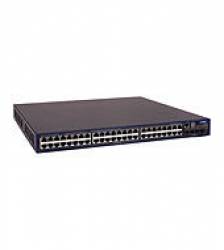
HP JD317A switch 48x TP 100 Mbit 4x SFP slot
| Lieske Part No. | 245814 |
|---|---|
| Mfg Part No | JD317A |
| EAN-Code | 0885631183564 |
| Manufacturer | HP |
| Here only | 952,00 EUR
1.132,88 EUR incl. VAT
|
Further information for HP JD317A switch 48x TP 100 Mbit 4x SFP slot
| General | |
| Number of RJ-45 ports | 48 |
| Ethernet standard | IEEE 802.3, IEEE 802.3u |
| Speed of RJ-45 ports | 10/100 Mbit/s |
| Number of SFP ports | 4 |
| SFP technology | Gigabit Ethernet |
| Console port | RJ-45 serial |
| Layer | 2 |
| Autosensing | |
| QoS | |
| VLAN support | |
| ACL | |
| SSHv2 | |
| IGMP Snooping | |
| GVRP | |
| HGMP V2 | |
| MVR | |
| VCT | |
| QinQ | |
| Rate limiting | |
| MAC-IP-Port binding | |
| Endpoint Admission Defense | |
| Voice- and protocol-based VLANs | |
Applications
The switch is designed for use in enterprise networks, particularly in metropolitan networks or industrial networks where high security and intelligent network control are required. It serves to connect end devices or aggregate client devices with 10/100-Mbit/s connections, consolidating data streams at a switch with higher capacity (1000 Mbit/s). Integrated functions such as Quality of Service (QoS), access control (ACL), and VLAN support make it suitable for structured networks where prioritization and security are important.
Functions and Equipment in Detail
The switch offers advanced network functions including Rate Limiting, QinQ (VLAN/VPN), SSHv2, Multicast VLAN Registration (MVR), Virtual Cable Test (VCT), HGMP V2, GARP VLAN Registration Protocol (GVRP), MAC-IP-Port binding, and Endpoint Admission Defense. These functions support network security, VLAN management, and monitoring of network connections. Support for voice- and protocol-based VLANs enables fine-grained control of network resources. The Internet Group Management Protocol Snooping (IGMP Snooping) function optimizes multicast traffic in the network.
Technology Explained Simply
The 48 RJ-45 ports support automatic speed detection (autosensing) and operate in half- or full-duplex mode, enabling flexible use in various network scenarios. The SFP ports are designed for integration of SFP transceivers, which can be used for fiber optic connections or longer copper cables. The serial console interface allows direct, cable-based configuration, which is particularly useful during commissioning or maintenance work. Layer-2 functionality includes packet forwarding based on MAC addresses and VLAN support, improving network segmentation and security.
Compatibility and Accessories
The switch is compatible with various SFP transceivers, including models such as JD099B (BX 10-D/LC), JD098B (BX 10-U/LC), JD063B (LH70/LC), as well as general SFP transceivers for 1000 Mbit/s. For connecting to other devices, patch cables with RJ-45 connectors in various lengths and categories (CAT5e, CAT6) are suitable. The use of S-STP (S/FTP) or FTP (F/UTP) cables is possible depending on the shielding requirements.
Mounting and Installation
The switch is designed for use in standard 19-inch racks and can be mounted there. Installation is carried out using the integrated mounting holes. The serial console interface requires a corresponding cable connection, for example via an RJ-45-to-DB9 adapter cable, to perform configuration through a terminal or PC connection. Network connections are made using RJ-45 patch cables to end devices or other switches.
Operational Advantages
Integrated functions such as QoS, ACL, and VLAN support enable efficient network management and security. The automatic speed detection of the RJ-45 ports ensures easy integration into existing networks. The SFP ports offer flexibility when connecting to other network elements, especially over fiber optic or longer copper cables. The serial console interface provides a reliable method for direct device configuration, independent of network availability. Support for protocols such as IGMP Snooping and GVRP optimizes multicast traffic and VLAN management in the network.

This is an offer of:
79279 Vörstetten
https://industry-electronics.com
Tel. 07666/88499-0
Fax. 07666/88499-111
Diesen Artikel finden Sie unter:
industry-electronics.com/artikel/245814

Lieske Elektronik e.K.
Reutener Str. 1079279 Vörstetten
https://industry-electronics.com
Tel. 07666/88499-0
Fax. 07666/88499-111
Diesen Artikel finden Sie unter:
industry-electronics.com/artikel/245814