
HP JD304A switch 8x TP 100 Mbit 1x TP 1000 Mbit
Networks > Switches
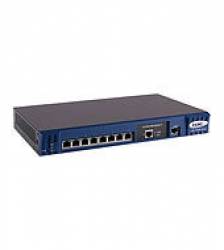
HP JD304A switch 8x TP 100 Mbit 1x TP 1000 Mbit
| Lieske Part No. | 472493 |
|---|---|
| Mfg Part No | JD304A |
| EAN-Code | 0885631181041 |
| Manufacturer | HP |
| Here only | 310,08 EUR
369,00 EUR incl. VAT
|
Further information for HP JD304A switch 8x TP 100 Mbit 1x TP 1000 Mbit
| General | |
| Product type | managed Switch |
| Port count | 8 Number of 10/100 Mbit/s ports |
| Uplink port | 1 Number of 1000 Mbit/s ports |
| Technology | Layer-2 switch |
| Connection type | RJ45 |
| Network technology | Ethernet |
| Bandwidth | 10/100 Mbit/s for Downlink ports |
| Stackable | |
Applications
This switch is suitable for small to medium-sized networks requiring a cost-effective yet manageable infrastructure. It can be used in office and administrative environments as an access switch for end devices with 100 Mbit/s bandwidth. In industrial or metropolitan networks (MANs), it serves to aggregate multiple smaller switches via 100 Mbit/s interfaces, with the Uplink connected to a larger Layer-3 switch or IP switching center via a Gigabit-Ethernet connection. The stackability allows for scaling the network infrastructure without adding management complexity.
Functions and Features in Detail
The switch offers eight RJ45 ports with 10/100 Mbit/s speed, suitable for connecting end devices such as computers, printers, or IP phones. An additional RJ45 port supports 1000 Mbit/s and serves as an Uplink connection to establish data connectivity to a central switch or router. Support for Link Aggregation allows combining multiple physical connections into a single logical one, increasing overall bandwidth and improving connection reliability. The devices are designed as Layer-2 switches, meaning they operate at the data link layer (Layer 2 of the OSI model) and forward packets based on MAC addresses.
Technology Explained Simply
The term managed means the switch includes network management functions, allowing settings such as VLANs, port forwarding, QoS, or security configurations to be adjusted via a web interface or CLI (Command Line Interface). Stackability enables connecting multiple switches so they can be managed as a single logical device, simplifying network administration. Link Aggregation combines multiple physical connections into a single logical connection to increase bandwidth and create redundancy. The Gigabit-Ethernet Uplink function ensures fast connectivity to the central network, minimizing latency.
Compatibility and Accessories
For connecting to end devices or other network components, various patch cables compatible with the switch are available. These include, for example, CAT5e patch cables with 100 MHz bandwidth in lengths from 0.25 m to 5 m, and CAT6 cables with 250 MHz bandwidth in lengths from 0.5 m to 15 m. The cables are typically constructed as S-STP (S/FTP) or FTP (F/UTP) and comply with standards for shielded network cables. These cables enable reliable data transmission and are suitable for use in environments with electromagnetic interference.
Mounting and Installation
The switch is designed for desktop use and can be placed on a table or in a rack without additional mounting accessories. Installation is performed via connection points to existing network components, with cabling done using RJ45 connectors. Network management is done via a web interface accessible through a standard web browser or via CLI. Configuration requires basic knowledge of networking, particularly when setting up VLANs, port forwarding, or QoS settings.
Operational Advantages
The switch provides a cost-effective solution for networks requiring high port density at moderate pricing. The management functions enable centralized control and monitoring of network resources, simplifying maintenance and troubleshooting. Stackability and Link Aggregation enhance network scalability and reliability. The combination of 10/100 Mbit/s ports and a Gigabit-Ethernet Uplink ensures balanced performance suitable for use in small and medium enterprises as well as industrial applications.

This is an offer of:
79279 Vörstetten
https://industry-electronics.com
Tel. 07666/88499-0
Fax. 07666/88499-111
Diesen Artikel finden Sie unter:
industry-electronics.com/artikel/472493

Lieske Elektronik e.K.
Reutener Str. 1079279 Vörstetten
https://industry-electronics.com
Tel. 07666/88499-0
Fax. 07666/88499-111
Diesen Artikel finden Sie unter:
industry-electronics.com/artikel/472493