
HP J9575A switch 24xTP 2xSFP/SFP+ stackable
Networks > Switches
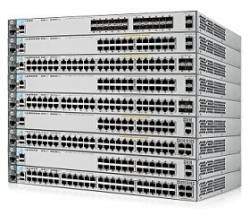
HP J9575A switch 24xTP 2xSFP/SFP+ stackable
| Lieske Part No. | 975563 |
|---|---|
| Mfg Part No | J9575A |
| EAN-Code | 0886112091514 |
| Manufacturer | HP |
| Here only | 4.022,10 EUR
4.786,30 EUR incl. VAT
|
Further information for HP J9575A switch 24xTP 2xSFP/SFP+ stackable
| General | |
| Number of RJ-45 ports | 24 |
| RJ-45 data rates | 10/100/1000 Mbit/s |
| Standard RJ-45 | IEEE 802.3, IEEE 802.3u, IEEE 802.3ab |
| Duplex modes RJ-45 | 10BASE-T/10e0BASE-TX: half or full, 1000BASE-T: full only |
| Number of SFP+ ports | 2 |
| SFP+ data rates | 1000/10000 Mbit/s |
| Serial console port | RJ-45 |
| Out-of-band management port | RJ-45 |
| Stacking module slot | 1 |
| Autosensing | |
Applications
The switch is designed for use in medium to large networks, particularly in enterprises requiring a scalable and manageable network infrastructure. Support for stacking via an integrated stacking module slot allows multiple switches to be linked into a logical unit, simplifying network management and increasing bandwidth between devices. This is especially advantageous in environments with high demands on network performance and management convenience.
Functions and Equipment in Detail
In addition to the 24 RJ-45 ports and two SFP+-ports, the switch features an RJ-45 serial console port for direct configuration and maintenance of the device via a terminal cable. Another RJ-45 port serves as an out-of-band management port, enabling a separate connection to the network management system, independent of the main network traffic. This function is essential for maintaining and monitoring the switch, especially in critical environments where interruption of the main network must be avoided.
Technology Explained Simply
The integrated SFP+-ports offer flexible expansion options for high-speed connections. They can be equipped with various transceivers, such as SFP+-LRM modules for connections up to 220 meters, or SFP+-DAC cables for short, cabled connections within a data center. The automatic detection of transmission rate (autosensing) at the RJ-45 ports ensures that devices are optimally adapted to connected end devices without manual settings. Support for full-duplex operation at 1000BASE-T maximizes data transfer performance and minimizes collisions in the network.
Compatibility and Accessories
The switch is compatible with various accessory components offered in the product line. These include patch cables of categories CAT5e and CAT6 in various lengths and configurations, such as S-STP(S/FTP) or FTP (F/UTP), as well as SFP and SFP+ transceivers for different transmission media and distances. The use of SFP+ Direct-Attach cables (DAC) is also possible to create cost-effective, short connections between switches or servers. The stacking function requires a special stacking module, which is inserted into the integrated slot.
Mounting and Installation
The switch is designed for use in standard 19-inch racks and can be mounted there. Installation is carried out using the integrated mounting holes and screws intended for rack fixation. Cabling of the RJ-45 ports is done via standard Ethernet cables, with the use of CAT6 cables recommended for 1000BASE-T connections to ensure maximum bandwidth. Configuration is performed via the serial console or the out-of-band management interface, with the exact procedure described in the manufacturer’s technical documentation.
Operational Advantages
The combination of 24 Gigabit Ethernet ports and two SFP+-ports provides high port density and flexibility for various network environments. The stacking function enables a scalable network architecture that can be easily expanded without requiring additional management systems. Support for out-of-band management ensures reliable network administration, even if the main network fails. The integrated management ports facilitate maintenance and configuration, especially in complex networks with many devices.

This is an offer of:
79279 Vörstetten
https://industry-electronics.com
Tel. 07666/88499-0
Fax. 07666/88499-111
Diesen Artikel finden Sie unter:
industry-electronics.com/artikel/975563

Lieske Elektronik e.K.
Reutener Str. 1079279 Vörstetten
https://industry-electronics.com
Tel. 07666/88499-0
Fax. 07666/88499-111
Diesen Artikel finden Sie unter:
industry-electronics.com/artikel/975563