
HP J9142B SFP transceiver 1000 Mbit/s single-mode 1x LC
Networks > Accessories > Modules / extensions
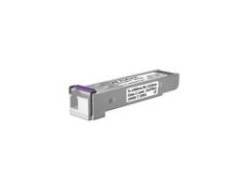
HP J9142B SFP transceiver 1000 Mbit/s single-mode 1x LC
| Lieske Part No. | 138793 |
|---|---|
| Mfg Part No | J9142B |
| EAN-Code | 0884420143369 |
| Manufacturer | HP |
| Here only | 950,88 EUR
1.131,55 EUR incl. VAT
|
Further information for HP J9142B SFP transceiver 1000 Mbit/s single-mode 1x LC
| General | |
| Manufacturer | HP |
| Technology | 1000BASE-BX-D |
| Fibre type | Single-Mode |
| Connector | LC |
| Data rate | 1000 Mbit/s |
| Transmission wavelength | 1490 nm |
| Receiving wavelength | 1310 nm |
Applications
This SFP module is designed for use in network infrastructures, particularly in switches and routers from the HP product family equipped with SFP slots. It is typically used in environments requiring high bandwidth and long transmission distances, such as corporate networks, data centers, or connecting network segments over greater distances. The use of single-mode fiber enables a reach of up to 20 km, making it suitable for backbone connections and long-distance links within buildings or between locations.
Functions and Features in Detail
The module operates according to the 1000BASE-BX-D standard, which defines asymmetric transmission: the transmit wavelength is 1490 nm, and the receive wavelength is 1310 nm. These wavelengths are optimized for use with single-mode fibers and ensure high signal quality over long distances. The LC connector enables a secure and precise connection with fiber optic cables equipped with LC connectors. The module is compact and fits into standard SFP slots, allowing easy integration into existing network devices.
Technology Explained Simply
An SFP transceiver is a modular network device that converts electrical signals from a network device into optical signals and vice versa. The J9142B module uses single-mode fiber, which transmits only one light mode, enabling high bandwidth and low attenuation. The BX-D technology (Bidirectional, Downstream) allows the use of a single fiber cable for both transmission directions by using different wavelengths for transmitting and receiving. This reduces the number of required fibers and lowers installation costs. The LC connector is a standard in fiber optic communication and ensures a reliable mechanical and optical connection.
Compatibility and Accessories
The module is specifically developed for HP switches and can be used in devices that support SFP modules. It is compatible with other SFP modules that meet the 1000BASE-BX-D standard. As suitable accessories, another SFP module with the specifications GBIC-Mini SFP 1000 WDM/LC Tx1490nm/Rx1310nm 9u for HP(Aruba) 20km HP-Code is offered, also intended for use in HP network devices. The combination of both modules enables a bidirectional connection over a single fiber optic cable, with one module installed at the transmitting end and the other at the receiving end.
Installation and Mounting
The installation of the SFP module is performed by simply inserting it into the corresponding SFP slot of the network device. It is important that the module is fully inserted and the connector is correctly connected to the fiber cable. The connection should be carefully checked to ensure optimal signal transmission. No additional tools or adapters are required, as the module fits directly into the slot.
Operational Advantages
The module provides reliable and high-performance data transmission over long distances, with the use of single-mode fiber and BX-D technology reducing the number of required fibers. The LC connector ensures a stable mechanical connection, and compatibility with HP switches enables easy integration into existing networks. The compact module size facilitates placement in devices with limited SFP slot availability. Operational reliability is supported by robust construction and the use of proven technologies.

This is an offer of:
79279 Vörstetten
https://industry-electronics.com
Tel. 07666/88499-0
Fax. 07666/88499-111
Diesen Artikel finden Sie unter:
industry-electronics.com/artikel/138793

Lieske Elektronik e.K.
Reutener Str. 1079279 Vörstetten
https://industry-electronics.com
Tel. 07666/88499-0
Fax. 07666/88499-111
Diesen Artikel finden Sie unter:
industry-electronics.com/artikel/138793