
HP J9100B SFP transceiver 100 Mbit/s BX-U LC upstream
Printers/Scanners > Parts
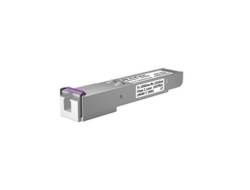
HP J9100B SFP transceiver 100 Mbit/s BX-U LC upstream
| Lieske Part No. | 827933 |
|---|---|
| Mfg Part No | J9100B |
| EAN-Code | 0884420143352 |
| Manufacturer | HP |
| Here only | 295,26 EUR
351,36 EUR incl. VAT
|
Further information for HP J9100B SFP transceiver 100 Mbit/s BX-U LC upstream
| General | |
| Transceiver type | SFP |
| Data rate | 100 Mbit/s |
| Operation mode | Full-Duplex |
| Fibre type | Single-Mode |
| Plug connection | LC |
| Transmission range | 10 km |
| Transmit wavelength | 1310 nm |
| Receiving wavelength | 1550 nm |
| Norm | IEEE 802.3ah Type 100BASE-BX10-U |
| Fibre standard | ITU-T G.652 |
| Direction | Upstream |
Applications
The J9100B is suitable for connecting network devices over long distances, particularly in enterprise networks, where the use of fiber optic cables reduces cabling complexity and increases reach. The maximum reach is 10 km, with transmission occurring over a single fiber strand. This reduces the number of required fibers compared to conventional duplex connections. Typical use cases include campus networks, connecting switches in different buildings, or linking remote locations.
Functions and Features in Detail
The transceiver operates in full-duplex mode, meaning data can be transmitted in both directions simultaneously without requiring time-division or switching of transmission direction. The transmit wavelength is 1310 nm, while the receive wavelength is 1550 nm. These wavelengths are typical for bidirectional (BX) transmission over a single fiber strand, with the J9100B acting as the upstream transceiver, transmitting data toward the central network. The connection is made via an LC connector, standardized for compact form factors in networks.
Technology Explained Simply
The J9100B technology uses bidirectional (BX) fiber transmission, where two different wavelengths (1310 nm and 1550 nm) are transmitted over a single fiber strand. This halves the number of fibers required, which is particularly advantageous when fiber capacity is limited or when extending existing cabling. Single-mode fiber (SMF) enables high bandwidth and low attenuation, allowing a reach of up to 10 km. The LC connector is compact and standard in modern network devices. The IEEE 802.3ah standard defines specifications for 100BASE-BX10-U, ensuring interoperability with other devices.
The ITU-T G.652 standard describes the physical properties of the fiber optic cable used, particularly the wavelength ranges and attenuation characteristics required for transmission. Compliance with these standards ensures compatibility with common fiber optic cables.
Compatibility and Accessories
The J9100B is specifically designed for use with the J9099B (downstream transceiver). Both transceivers must be used in pairs to enable bidirectional communication over a single fiber strand. The connection is made via a single-mode fiber cable with LC connector. It is important that the fiber complies with the ITU-T G.652 standards to ensure reliable transmission. Use with other transceiver types is not intended, as the wavelengths and functionality are specifically matched to the J9100B/J9099B pair.
Installation and Mounting
The transceiver is inserted directly into an SFP slot of a compatible network device (e.g., switch). Installation is performed by simply plugging it into the appropriate port, with the LC connector connected to the fiber cable. It is essential to ensure the device is powered off before inserting the transceiver to avoid damage. The connection to the partner transceiver (J9099B) must be made via a single-mode fiber cable with LC connector. Correct wavelength alignment (1310 nm for transmission, 1550 nm for reception) is critical for proper functionality.
Operational Advantages
Using the J9100B enables efficient use of fiber capacity, as only a single fiber strand is required for bidirectional communication. The reach of up to 10 km makes it suitable for long-distance connections without requiring additional amplifiers or intermediate stations. The use of single-mode fiber ensures high signal quality and low attenuation, resulting in a stable and reliable network connection. Compatibility with the IEEE 802.3ah standard and the ITU-T G.652 standard ensures interoperability with other devices and cables.

This is an offer of:
79279 Vörstetten
https://industry-electronics.com
Tel. 07666/88499-0
Fax. 07666/88499-111
Diesen Artikel finden Sie unter:
industry-electronics.com/artikel/827933

Lieske Elektronik e.K.
Reutener Str. 1079279 Vörstetten
https://industry-electronics.com
Tel. 07666/88499-0
Fax. 07666/88499-111
Diesen Artikel finden Sie unter:
industry-electronics.com/artikel/827933