
Helukabel 64193 cable H07V2-K 1x10 mm² grey
Cables > Installation systems and industrial management > Wiring cable H05 / 07V-K
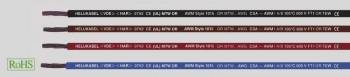
Helukabel 64193 cable H07V2-K 1x10 mm² grey
| Lieske Part No. | 1773001 |
|---|---|
| Mfg Part No | 64193 |
| EAN-Code | 4060892191381 |
| Manufacturer | Helukabel |
| Here only | 3,24 EUR
3,86 EUR incl. VAT
|
Further information for Helukabel 64193 cable H07V2-K 1x10 mm² grey
| General | |
| Standards | DIN VDE 0285-525-2-31, DIN EN 50525-2-31, UL Std.1063, UL Style 10269, CSA-TEW, CSA-AWM I A/B |
| Conductor material | Cu stranded wire bare fine-stranded in accordance with DIN VDE 0295 Class 5 |
| Insulation material | PVC compound type TI3 according to DIN VDE 0207-363-3 |
| Conductor marking | according to DIN VDE 0293 |
| Nominal voltage | up to 1 mm²: 300/500 V, from 1.5 mm²: 450/750 V V |
| Test voltage | H05V2-K: 2000 V, H07V2-K: 2500 V V |
| Insulation resistance | min. 20 MΩ·km |
| Temperature range in motion | +5°C to +90°C |
| Temperature range, non-operating | -40°C to +90°C |
| Temperature range UL (AWM) | -40°C to +105°C |
| Temperature range CSA (TEW) | -40°C to +105°C |
| Minimum bending radius fixed installation | ≥ 8 mm: 4x conductor Ø, > 8–12 mm: 5x conductor Ø, > 12 mm: 6x conductor Ø |
| Test voltage spark test | 0,5 mm²: 5 kV, 0,75 mm²: 6 kV kV |
| Flame retardancy | DIN VDE 0482-332-1-2, UL VW-1, CSA FT1 |
| Material release | Silicon- and cadmium-free, free of substances interfering with paint adhesion |
| CE marking | Compliant with Low Voltage Directive 2014/35/EU |
| Regulation lengths | 100 m, 500 m |
Applications
The cable is intended for use in industrial plants, machines and equipment, particularly in environments where high mechanical and thermal load capacity is required. It is suitable for fixed installation as well as for moving applications, with temperature resistance varying depending on the standard and application type. The cable is designed for indoor use and under protected conditions, with the exact environmental class depending on the respective standard.
Functions and Equipment in Detail
The cable consists of a bare, fine-stranded copper wire according to DIN VDE 0295 class 5, offering high flexibility and mechanical strength. The conductor insulation is made of a PVC mixture type TI3, complying with the requirements of DIN VDE 0207-363-3, DIN EN 50363-3 as well as CSA-C 22.2 No. 210. The conductor identification follows DIN VDE 0293, enabling unambiguous identification of individual conductors. The materials used are free of silicone, cadmium and substances that could impair paint adhesion, improving processability in painting processes.
Technology Explained Simply
The cable is rated for a nominal voltage of up to 450/750 V when the cross-section is ≥1.5 mm². For smaller cross-sections (≤1 mm²), the nominal voltage is 300/500 V. The test voltage is 2500 V for H07V2-K and 2000 V for H05V2-K, ensuring high electrical insulation performance. The insulation resistance values are at least 20 MΩ·km, ensuring reliable electrical separation between conductors. The test voltages in the spark test are 5 kV for 0.5 mm² and 6 kV for 0.75 mm², confirming electrical strength under dynamic conditions. The minimum bending radius for fixed installation is 4 times the conductor diameter for up to 8 mm, 5 times for 8–12 mm, and 6 times for over 12 mm, enabling flexible installation.
Compatibility and Accessories
The cable is designed for use in systems requiring the standards HAR, UL-AWM, UL-MTW, CSA-AWM and CSA-Equipment-wire. These approvals enable use in various international markets, particularly in the USA and Canada. The cable is intended for use in electrical installations and machines requiring high reliability and safety. Use in combination with other components follows the respective standards and technical specifications.
Installation and Mounting
The cable is designed for fixed installation and can be installed in enclosures, machines and equipment. The flexibility and minimum bending radius allow flexible installation, with exact values depending on the conductor diameter. Installation follows applicable regulations and standards, particularly DIN VDE 0100 and DIN EN 60332-1-2. The cable is self-extinguishing and flame retardant, increasing safety during installation.
Operational Advantages
The fivefold approval enables reduction of stock levels and simplification of bill of materials. High electrical strength, mechanical robustness and thermal resistance ensure long service life and reliable operation. Material release regarding silicone and cadmium, as well as paint adhesion stability, facilitates processing in painting processes. The cable is available in standard lengths of 100 m and 500 m, simplifying planning and installation.
Protection Class and Environmental Resistance
The cable is not designed for outdoor use or in damp environments without additional protection. Temperature resistance varies by standard: for moving installation from +5°C to +90°C, for fixed installation from -40°C to +90°C. UL and CSA standards allow a temperature range up to +105°C, enabling higher thermal load capacity. The cable is not intended for use in explosive environments.
Testing and Safety Features
The PVC insulation is self-extinguishing and flame retardant according to DIN VDE 0482-332-1-2, DIN EN 60332-1-2 and IEC 60332-1-2, corresponding to test type B of DIN VDE 0472 part 804. Additionally, the cable meets UL VW-1 and CSA FT1 tests, confirming flame retardancy in various markets. The cable is intended for use in electrical installations and machines requiring high safety standards.

This is an offer of:
79279 Vörstetten
https://industry-electronics.com
Tel. 07666/88499-0
Fax. 07666/88499-111
Diesen Artikel finden Sie unter:
industry-electronics.com/artikel/1773001

Lieske Elektronik e.K.
Reutener Str. 1079279 Vörstetten
https://industry-electronics.com
Tel. 07666/88499-0
Fax. 07666/88499-111
Diesen Artikel finden Sie unter:
industry-electronics.com/artikel/1773001