
Helukabel 10903 cable 1G240 mm² black
Cables > Installation systems and industrial management > Wiring cable H05 / 07V-K
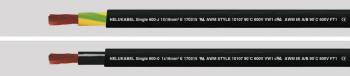
Helukabel 10903 cable 1G240 mm² black
| Lieske Part No. | 469139 |
|---|---|
| Mfg Part No | 10903 |
| EAN-Code | 4060892172564 |
| Manufacturer | Helukabel |
| Here only | 81,45 EUR
96,93 EUR incl. VAT
|
Further information for Helukabel 10903 cable 1G240 mm² black
| General | |
| Standards | UL Style 10107, CSA AWM I/II A/B, DIN VDE 0285-525-2-31, DIN EN 50525-2-31, DIN VDE 0285-525-2-51, DIN EN 50525-2-51, UL Std.758 |
| Temperature range in motion | -5 °C |
| Temperature range, non-operating | -40 °C |
| Permissible operating temperature on conductor | 90 °C |
| Rated voltage VDE | 600/1000 V |
| Rated voltage UL/CSA | 600 V |
| Test voltage | 4000 V |
| Dielectric strength | 8000 V |
| Minimum bending radius moving | 7.5x cable Ø |
| Minimum bending radius not moved | 4x wire Ø |
| Radiation resistance | 80x106 cJ/kg |
| Conductor construction | Cu-stranded wire bare, fine-stranded |
| Wire insulation | Special PVC Class 43, 90°C |
| Outer sheath | special PVC compound type TM2 |
| Sheath colour | Black |
| Sheath colour RAL | 9005 |
| Material freedom | Silicon- and cadmium-free, free of substances interfering with paint adhesion |
| Tests | DIN VDE 0482-332-1-2, DIN EN 60332-1-2, IEC 60332-1-2, UL VW-1, CSA FT1 |
| Utilization | Flexible application with free movement without tensile stress, in dry, damp, wet rooms and outdoors (fixed installation) |
| Regulation lengths | 500 m, 1000 m |
| Meter marking | |
| UV resistance | |
| Flame retardancy | |
| Self-extinguishing | |
Applications
The cable is designed for moderate mechanical stress and is suitable for applications requiring flexible wiring, but without continuous tensile load or forced movement. It is frequently used in industrial electrical installations, particularly in environments exposed to UV radiation, as the materials used are UV-resistant. Outdoor use is possible as long as the cable is permanently installed and does not come into direct contact with soil or water.
Functions and Equipment in Detail
The cable consists of a Cu conductor, bare and fine-stranded, according to DIN VDE 0295 Class 5, BS 6360 Class 5, and IEC 60228 Class 5. The core insulation is made of special PVC Class 43, certified for an operating temperature of 90°C according to UL Standard 1581. The insulation color is black or green-yellow. The outer sheath is made of a special PVC compound type TM2, meeting the requirements of DIN VDE 0207-363-4-1 and DIN EN 50363-4-1, and also classified as Class 43 according to UL Standard 1581. The sheath color is black (RAL 9005). The cable is marked with a meter marking to facilitate length measurement during installation.
Technology Explained Simply
The cable is rated for a nominal voltage of 600/1000 V (VDE) or 600 V (UL/CSA). The test voltage is 4000 V, and the breakdown voltage is at least 8000 V. The permissible operating temperature at the conductor is +90°C. For moving applications, the temperature range is between -5°C and +90°C; for non-moving applications, between -40°C and +90°C. The minimum bending radius is 7.5 times the cable diameter for moving applications and 4 times the cable diameter for non-moving applications. The radiation resistance is up to 80x10⁶ cJ/kg (80 Mrad), enabling suitability for environments with increased radiation exposure. The materials used are free of silicone, cadmium, and substances interfering with paint adhesion, improving processability and compatibility with painting processes.
Compatibility and Accessories
The cable is designed for use in industrial plants and machines, particularly in export-oriented production environments. It is compatible with standard installation techniques and components intended for PVC multi-core cables. No special accessories are required, as the cable is standardly designed for processing with common tools and connection techniques.
Installation and Mounting
Installation is carried out by permanent laying in dry, damp, or wet rooms, as well as outdoors. The cable must not be laid directly in soil or water. For moving applications, a minimum bending radius of 7.5 times the cable diameter must be observed; for non-moving applications, 4 times the cable diameter. The meter marking facilitates length measurement and positioning during installation. The cable is UV-resistant, enabling outdoor use under sunlight exposure.
Operational Advantages
The cable offers high mechanical and thermal load capacity, is flame-retardant and self-extinguishing according to DIN VDE 0482-332-1-2, DIN EN 60332-1-2, IEC 60332-1-2 (equivalent to DIN VDE 0472 Part 804 Test Method B), UL VW-1, and CSA FT1. The radiation resistance up to 80 Mrad makes it suitable for applications in environments with increased radiation exposure. The use of silicone- and cadmium-free materials ensures high compatibility with painting processes. The cable is available in standard lengths of 500 m and 1000 m.

This is an offer of:
79279 Vörstetten
https://industry-electronics.com
Tel. 07666/88499-0
Fax. 07666/88499-111
Diesen Artikel finden Sie unter:
industry-electronics.com/artikel/469139

Lieske Elektronik e.K.
Reutener Str. 1079279 Vörstetten
https://industry-electronics.com
Tel. 07666/88499-0
Fax. 07666/88499-111
Diesen Artikel finden Sie unter:
industry-electronics.com/artikel/469139