
Harting 09990000110 Crimping Pliers
Tools > Pliers > Crimping
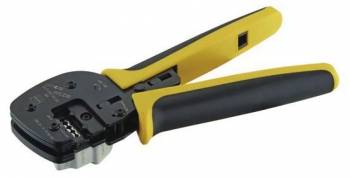
Harting 09990000110 Crimping Pliers
| Lieske Part No. | 380737 |
|---|---|
| Mfg Part No | 09990000110 |
| EAN-Code | 5713140105577 |
| Manufacturer | Harting |
| Here only | 390,59 EUR
464,80 EUR incl. VAT
|
Further information for Harting 09990000110 Crimping Pliers
| General | |
| Conductor cross section | 0,14...4 mm² |
| Compatibility Han D | 0,14...1,5 mm² |
| Compatibility Han E | 0,5...4 mm² |
| Compatibility Han-Yellock | 0,5...4 mm² |
| Compatibility Han C | 1,5...4 mm² |
| Suitable for contacts | 09 15 000 6104/6204 as well as 09 15 000 6124/6224 in the range 0.14...0.37 mm² |
Applications
The crimping plier is used in professional environments where a secure and durable electrical connection is required. It is particularly suitable for mounting connectors in industrial plants, communication infrastructures, and electrical installations. The plier enables processing of conductors with a cross-section from 0.14 to 4 mm², with the exact application varying depending on the contact system. For the Han D contact system in the range of 0.14 to 0.37 mm², the plier is only compatible with the specific contacts 09 15 000 6104/6204 and 09 15 000 6124/6224.
Functions and Equipment in Detail
The tool is designed as a hand crimping tool, meaning it is operated manually without electric or pneumatic drives. The crimping plier features multiple tool inserts optimized for the different contact systems. The tool inserts enable precise shaping of the contact to ensure a secure and electrically reliable connection. The plier is designed for processing conductors with a cross-section from 0.14 to 4 mm², with the exact ranges varying depending on the contact system: Han D (0.14–1.5 mm²), Han E (0.5–4 mm²), Han-Yellock (0.5–4 mm²), and Han C (1.5–4 mm²).
Technology Explained Simply
The crimping plier operates on the principle of mechanical deformation. During crimping, the contact is shaped around the conductor using a specific tool insert, creating a secure mechanical and electrical connection. The plier is constructed to be compatible with various contact systems, with the tool inserts replicating the respective geometries of the contacts. Processing is done manually, allowing the user to control the force and positioning, which is particularly advantageous for sensitive or complex connections.
Compatibility and Accessories
The plier is specifically designed for the Han D, Han E, Han-Yellock, and Han C contact systems. Compatibility is defined according to the contact system and conductor cross-section: Han D supports cross-sections from 0.14 to 1.5 mm², with only contacts 09 15 000 6104/6204 and 09 15 000 6124/6224 allowed in the 0.14 to 0.37 mm² range. Han E, Han-Yellock, and Han C each cover the range of 0.5 to 4 mm², with Han C only available from 1.5 mm². The plier is not intended for other contact systems or conductor cross-sections outside the specified ranges.
Mounting and Installation
Mounting is done by manual crimping: the conductor is inserted into the contact, and the plier is closed over the contact, shaping it around the conductor. The precise shaping is achieved through the tool inserts, which are optimized for the respective contact systems. The plier requires no additional tools or accessories; processing is done directly on the workpiece. Handling is simple and does not require special training, although proper application is necessary to ensure a reliable connection.
Advantages in Operation
The crimping plier offers high precision when processing various contact systems. Manual operation allows for precise force control, which is particularly beneficial for sensitive or complex connections. The plier is robust and designed for professional use, ensuring long service life and high reliability. Compatibility with multiple contact systems reduces the number of tools required in operation, increasing efficiency.

This is an offer of:
79279 Vörstetten
https://industry-electronics.com
Tel. 07666/88499-0
Fax. 07666/88499-111
Diesen Artikel finden Sie unter:
industry-electronics.com/artikel/380737

Lieske Elektronik e.K.
Reutener Str. 1079279 Vörstetten
https://industry-electronics.com
Tel. 07666/88499-0
Fax. 07666/88499-111
Diesen Artikel finden Sie unter:
industry-electronics.com/artikel/380737