
Goobay 67999 USB-C to USB-A Cable 0.5m black
Accessories > Cable / Adapter > USB
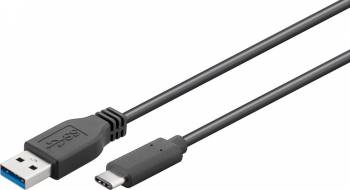
Goobay 67999 USB-C to USB-A Cable 0.5m black
| Lieske Part No. | 761296 |
|---|---|
| Mfg Part No | 67999 |
| EAN-Code | 4040849679995 |
| Manufacturer | Goobay |
| Here only | 4,62 EUR
5,50 EUR incl. VAT
|
Further information for Goobay 67999 USB-C to USB-A Cable 0.5m black
| Technical data | |
| Connection, type | USB-C |
| Connection 2, type | USB-C |
| Cable type | Tubular cable |
| Conductor, material | CU (Copper) |
| Colour version | Black |
| Colour | Black |
| Material | PVC |
| Consumption unit | 1 piece unpacked |
| Packaging type | Cable Tag |
| Standard | USB 3.0 |
| Max. power | 15 W |
| Cable length | 0.5 m |
| AWG | 28 |
| Max. data transfer rate | 5 Gbit/s |
| Markings | CE, WEEE |
Applications
This cable is suitable for use in office environments, home settings, and mobile applications where fast data transfer and simultaneous power supply are required. It can be used, for example, to charge smartphones, tablets, or laptops via a USB-A port on a computer or charging station. Additionally, it enables the transfer of films, music, videos, and files between a PC and an external display such as a TV or monitor. Compatibility with USB 3.0 (also known as USB 3.2 Gen 1) ensures high data transfer performance.
Functions and Features in Detail
The cable supports a maximum data transfer rate of 5 Gbit/s, equivalent to SuperSpeed data transfer, which is approximately ten times faster than USB 2.0. This speed allows for rapid synchronization and transfer of large data volumes. The maximum power output is 15 W, sufficient to efficiently charge USB-C-enabled devices. The maximum current is 3 A, which is adequate for most mobile devices. The cable is backward compatible with USB 2.0 and USB 1.1, ensuring functionality with older devices, albeit at the corresponding lower speeds.
Technology Explained Simply
The use of USB-C connectors at both ends (Type A and Type C) enables flexible connections between various devices. The USB-C connector at the device end is universally applicable, while the USB-A connector at the other end is designed for standard USB ports on computers, charging stations, or other devices. The use of PVC as the outer housing provides mechanical stability and protection against external influences. The inner housing is made of PE (polyethylene), ensuring good insulation and flexibility. The conductors are made of 7/0.12BC, enabling stable electrical performance. Insulation is provided by HDPE (high-density polyethylene), and an aluminum foil shield and cable braid (80/0.12AL) ensure electromagnetic shielding.
Compatibility and Accessories
The cable is suitable for all devices equipped with a USB-C port and compatible with USB 3.0. It can be connected to computers, laptops, smartphones, tablets, and other USB-C-enabled end devices. Connection to a USB-A port is achieved via the standard connector at the other end. Compliance with REACh and RoHS ensures the product is environmentally friendly and does not contain harmful substances.
Installation and Mounting
Installation is performed by simply plugging the USB-C connector into the USB-C device and the USB-A connector into the USB-A port. No additional tools or mounting procedures are required. The cable is delivered unpackaged and supplied as a single unit (1 pcs).
Operational Advantages
The cable offers a combination of fast data transfer and simultaneous power supply, making it particularly suitable for daily use. The high data transfer rate of 5 Gbit/s enables rapid transfer of large files, while the 15 W power output is sufficient to efficiently charge mobile devices. Backward compatibility with older USB versions expands its range of applications. The robust construction with nickel-plated contacts and PVC outer sheath ensures long service life and reliable performance.

This is an offer of:
79279 Vörstetten
https://industry-electronics.com
Tel. 07666/88499-0
Fax. 07666/88499-111
Diesen Artikel finden Sie unter:
industry-electronics.com/artikel/761296

Lieske Elektronik e.K.
Reutener Str. 1079279 Vörstetten
https://industry-electronics.com
Tel. 07666/88499-0
Fax. 07666/88499-111
Diesen Artikel finden Sie unter:
industry-electronics.com/artikel/761296