
Goobay 62363 AUX Extension Cable 3.5 mm 4-pin
Accessories > Cable / Adapter > TV / Video / Audio
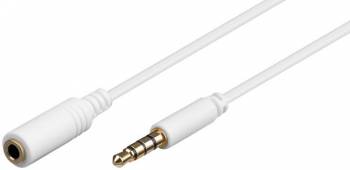
Goobay 62363 AUX Extension Cable 3.5 mm 4-pin
| Lieske Part No. | 736730 |
|---|---|
| Mfg Part No | 62363 |
| EAN-Code | 4040849623639 |
| Manufacturer | Goobay |
| Here only | 1,42 EUR
1,69 EUR incl. VAT
|
Further information for Goobay 62363 AUX Extension Cable 3.5 mm 4-pin
| Technical data | |
| Connection, contact material | Gilt |
| Connection, type | 3.5 mm jack plug (4-pin, stereo) |
| Connection 2, type | Jack 3.5-mm socket (4-pin, stereo) |
| Cable type | Tubular cable |
| Conductor, material | CU (Copper) |
| Colour | White |
| Consumption unit | 1 piece unpacked |
| Packaging type | Cable Tag |
| Cable length | 3 m |
| AWG | 28 |
| Markings | CE, WEEE |
| SCIP No. | 257a0fad-52ea-4eeb-8437-4771675eb124 |
| Chemical substance | Pb |
| CAS No. | 7439-92-1 |
Applications
This cable is commonly used in mobile audio and communication technology, such as extending headphone cables with integrated microphones or connecting audio sources to amplifiers, MP3 players, smartphones, or speakers. The 4-pin connector allows simultaneous transmission of stereo signals and microphone signals, which is required for headsets and similar devices. The cable length of 3 m provides sufficient flexibility to bridge larger distances between device and connection point without compromising signal quality.
Functions and Features in Detail
The cable is designed as a round cable, with an inner conductor made of copper (CU) and an AWG-28 cross-section. This cable gauge is standard for extension cables and ensures sufficient conductivity for moderate current levels. The gold-plated contacts at both ends enhance contact stability and prevent oxidation, extending the cable’s lifespan. The slim design of the plug facilitates easy insertion, especially into devices housed in protective cases or shells.
Technology Explained Simply
The 4-pin connector enables separation of left and right audio channels and transmission of a microphone signal, which is necessary for modern headphones with built-in microphones. The shielded cable reduces sensitivity to electromagnetic interference, which may originate from other electrical devices or wiring. The small bending radius of the cable improves handling and prevents unnecessary stress on the connectors, especially during frequent plugging and unplugging. The white colour of the cable is visually discreet and blends well in many environments.
Compatibility and Accessories
The cable is compatible with all devices featuring a 3.5 mm AUX port with 4-pin connector. This includes smartphones, tablets, laptops, MP3 players, Bluetooth adapters, headphones with microphones, car radios, and other audio devices. It can be used as a replacement or extension for existing cables to increase reach or allow more flexible device placement. Use with other cable types, such as 2-pin connectors, is not possible, as the pin count and signal assignment do not match.
Installation and Mounting
Installation is performed by simply inserting the plug into the corresponding socket on the device. No additional tools or mounting aids are required. The cable can be directly plugged into existing connectors, and the slim plug design allows easy handling even in restricted access areas, such as devices with protective casings. The connection is mechanically stable and can be disconnected without tools.
Operational Advantages
The cable provides reliable and interference-free audio transmission over a distance of 3 metres. The gold-plated contacts ensure long-lasting contact quality, while the shielded design protects signal integrity. The slim design and small bending radius enhance handling and reduce the risk of mechanical damage. The use of copper as the inner conductor ensures good electrical conductivity, which is essential for clear sound transmission. The cable is intended for indoor use and is suitable for daily use in offices, at home, or in mobile applications.

This is an offer of:
79279 Vörstetten
https://industry-electronics.com
Tel. 07666/88499-0
Fax. 07666/88499-111
Diesen Artikel finden Sie unter:
industry-electronics.com/artikel/736730

Lieske Elektronik e.K.
Reutener Str. 1079279 Vörstetten
https://industry-electronics.com
Tel. 07666/88499-0
Fax. 07666/88499-111
Diesen Artikel finden Sie unter:
industry-electronics.com/artikel/736730