
Goobay 59590 Fiber Cable Singlemode OS2 white 20m LC-APC
Networks > Cables > Miscellaneous
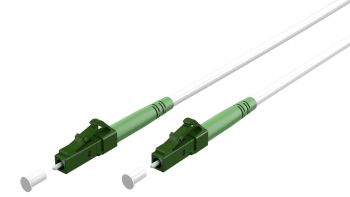
Goobay 59590 Fiber Cable Singlemode OS2 white 20m LC-APC
| Lieske Part No. | 1991445 |
|---|---|
| Mfg Part No | 59590 |
| EAN-Code | 4040849595905 |
| Manufacturer | Goobay |
| Here only | 10,98 EUR
13,06 EUR incl. VAT
|
Further information for Goobay 59590 Fiber Cable Singlemode OS2 white 20m LC-APC
| Technical data | |
| Connection, type | LC-APC (8°) connector |
| Connection 2, type | LC-APC (8°) connector |
| Cable fibre type | Fibre optic G.657.A2 |
| Cable jacket, material | LSZH |
| Cable type | Simplex cable |
| Colour version | White |
| Colour | White |
| Consumption unit | 1 piece in plastic bag |
| Packaging type | Bulk |
| Specification | Singlemode (OS2) White |
| Diameter of optical fibre core | 9 µ |
| Diameter of optical fibre jacket | 125 µ |
| Contacting | Ceramic Ferrule |
| LSZH-compliant | |
| Bend protection | |
Applications
This cable is specifically designed for FTTH applications and is compatible with fibre optic connections provided by suppliers such as Telekom Deutschland, Vodafone, and Deutsche Glasfaser. It is used indoors to establish the connection from the house connection point to the fibre optic modem. The bend-optimised single-mode fibre allows for space-saving installation without compromising signal quality. The minimum static bend radius is 30 mm, enabling flexible installation in confined spaces or when routing through cable ducts.
Functions and Features in Detail
The cable features two LC-APC (8°) connectors equipped with ceramic ferrules to ensure precise and stable light transmission. The connectors are supplied with dust caps to prevent contamination and damage. The strain relief is reinforced with aramid yarn, providing high mechanical stability and protection against tensile stress. The cable length is 20 m, and installation under static conditions should be carried out with a minimum bend radius of 30 mm.
Technology Explained Simply
The fibre used is a single-mode fibre (OS2) with a core diameter of 9 µm and a cladding diameter of 125 µm. This construction enables high bandwidth and low attenuation, especially at wavelengths of 1310 nm and 1550 nm. Attenuation is at most 0.4 dB/km at 1310 nm and at most 0.3 dB/km at 1550 nm. Insertion loss averages ≤ 0.12 dB, with 97 % of measurements ≤ 0.25 dB. Return loss for APC connectors is ≥ 60 dB, ensuring high signal quality and minimal reflections. The cable's operating temperature ranges from -40 °C to +85 °C, allowing use in various environments.
Compatibility and Accessories
The cable is designed for FTTH connections and can be connected to standard ONTs (Optical Network Terminals) and other fibre optic end devices. The use of LC-APC connectors ensures compatibility with common network equipment. The cable construction with LSZH jacket and aramid yarn strain relief meets requirements for indoor use and enclosed installations.
Installation and Mounting
Installation takes place indoors between the house connection point and the fibre optic modem. The cable is designed for static installation, requiring a minimum bend radius of 30 mm. The strain relief protects the cable from mechanical stress. Connection is made via the LC-APC connectors, which are supplied with dust caps to ensure a clean and stable connection.
Operational Advantages
The cable provides high signal quality through low attenuation and return loss, resulting in stable and reliable data transmission. The bend-optimised fibre allows flexible routing without affecting performance. The LSZH jacket increases safety in case of fire, as it does not release toxic gases. The use of aramid yarn ensures high mechanical stability and cable longevity. Individual testing with measurement of insertion loss and return loss guarantees high product quality and reliability.

This is an offer of:
79279 Vörstetten
https://industry-electronics.com
Tel. 07666/88499-0
Fax. 07666/88499-111
Diesen Artikel finden Sie unter:
industry-electronics.com/artikel/1991445

Lieske Elektronik e.K.
Reutener Str. 1079279 Vörstetten
https://industry-electronics.com
Tel. 07666/88499-0
Fax. 07666/88499-111
Diesen Artikel finden Sie unter:
industry-electronics.com/artikel/1991445