
Gerdes 2403 PrimuX 2S0 PCI-Express Server Controller
Networks > Modem > ISDN
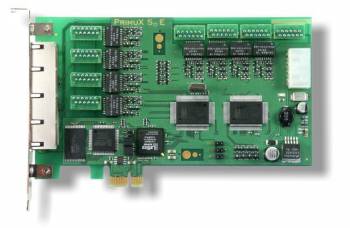
Gerdes 2403 PrimuX 2S0 PCI-Express Server Controller
| Lieske Part No. | 918360 |
|---|---|
| Mfg Part No | 2403 |
| EAN-Code | 4032783240300 |
| Manufacturer | Gerdes |
| Here only | 432,31 EUR
514,45 EUR incl. VAT
|
Further information for Gerdes 2403 PrimuX 2S0 PCI-Express Server Controller
| General | |
| Device type | ISDN terminal adapter |
| Interface type | PCI Express x1 |
| ISDN interface | BRI S0 |
| Number of digital connections | 2 |
| Supported protocols | ITU T.30, T.70NL, T.90NL, V.110 (I.463), X.25, X.75, HDLC |
| Data compression | MMR, MR |
| Operating systems | Linux, Microsoft Windows Server 2003, Windows Server 2008, Windows 98/2000/XP/Vista/7 |
| Scope of delivery | Drivers & Utilities |
| DTMF decoding | |
Applications
The PrimuX 2S0 is designed for use in servers requiring ISDN connections, for example in small to medium-sized enterprises, remote maintenance systems, or legacy infrastructures still dependent on ISDN technology. Use in servers running Windows Server 2003, 2008, as well as older Windows systems such as 98, 2000, XP, Vista, and 7 is supported. Linux systems are also compatible, with the necessary drivers and utilities included in the delivery scope.
Functions and Equipment in Detail
The device features two ISDN-BRI-S0 interfaces, each enabling a digital connection. The interfaces are designed for transmission of voice, data, and remote maintenance information over ISDN networks. Support for protocols such as ITU T.30, T.70NL, T.90NL, V.110 (I.463), X.25, X.75, and HDLC enables a wide range of application scenarios, including fax transmission, data communication, and network management. Additionally, DTMF decoding is supported, enabling detection of tone signals in telephone calls. Integrated data compression using MMR and MR methods optimizes transmission rates for image data, for example during fax transmissions.
Technology Explained Simply
The PrimuX 2S0 operates as a plug-in card inserted into a PCI Express x1 slot of the server. The ISDN connection is established via the two integrated BRI-S0 interfaces, each supporting a 64 kbit/s data channel (B-channel) and a 16 kbit/s signalling channel (D-channel). The D-channels are used for signalling and connection control, while the B-channels are used for actual data or voice transmission. The card is designed for servers equipped with a PCI Express x1 slot and requires no additional power supply, as it is powered through the slot.
Compatibility and Accessories
The controller is compatible with various operating systems, including Microsoft Windows Server 2003 and 2008, as well as Windows 98/2000/XP/Vista/7 and Linux. The necessary drivers and utilities are included in the delivery scope. Suitable accessories include other PrimuX models, such as external ISDN adapters like the PrimuX USB V2, as well as server controllers with different connection options such as 4S0 and 8S0, available in both PCI-Express and NT-server controller variants. These can be added according to requirements for the number of ISDN connections needed.
Installation and Mounting
Installation is performed by inserting the card into a free PCI Express x1 slot of the server. Physical mounting requires no additional tools, as the card is directly inserted into the slot. Software installation is carried out using the included drivers and utilities, available for the specified operating systems. Configuration is done via the system control panel or specific configuration tools included in the delivery scope.
Advantages in Operation
The PrimuX 2S0 provides a reliable and stable ISDN connection for server applications. Support for multiple protocols and integrated data compression increase the efficiency of data transmission. The five-year warranty offers security for use in critical server environments. The combination of two ISDN interfaces on a single card reduces space requirements in the server and simplifies management of multiple ISDN connections on one device.

This is an offer of:
79279 Vörstetten
https://industry-electronics.com
Tel. 07666/88499-0
Fax. 07666/88499-111
Diesen Artikel finden Sie unter:
industry-electronics.com/artikel/918360

Lieske Elektronik e.K.
Reutener Str. 1079279 Vörstetten
https://industry-electronics.com
Tel. 07666/88499-0
Fax. 07666/88499-111
Diesen Artikel finden Sie unter:
industry-electronics.com/artikel/918360