
Finder 385132400060 Coupling Relay 6A 240VAC 1NO
Industrial Material > Industrial relays and contactors > Electronic modules
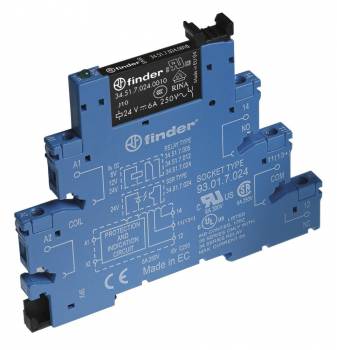
Finder 385132400060 Coupling Relay 6A 240VAC 1NO
| Lieske Part No. | 828681 |
|---|---|
| Mfg Part No | 385132400060 |
| EAN-Code | 8012823232126 |
| Manufacturer | Finder |
| Here only | 41,43 EUR
49,30 EUR incl. VAT
|
Further information for Finder 385132400060 Coupling Relay 6A 240VAC 1NO
| General | |
| Coil voltage | 240 V AC |
| Max. continuous current | 6 A |
| Nominal voltage | 250 V AC |
| Contact material | AgNi |
| Connection type | Screw connection |
| Number of contacts | 1 change-over contact |
| EMC filtering | Integrated |
| Residual current suppression | Integrated |
| Separation voltage | 6 kV |
| Clearance distance | 6 mm |
| Creepage distance | 8 mm |
| Mounting | DIN rail 35 mm |
| Max. switching capacity AC1 | 1500 VA |
| Max. switching power AC15 (230 V AC) | 300 VA |
| 1-phase motor load AC3 (230 V AC) | 0.185 kW |
| Max. switching current DC1 (24 V) | 6 A |
| Max. switching current DC1 (110 V) | 0.2 A |
| Max. switching current DC1 (220 V) | 0.12 A |
| Ambient temperature | +70 °C |
| LED indicator | |
Applications
The relay is designed for use in various industrial systems, including packaging machines, traffic light controls, programmable controls, operator panels, enclosures for electrical distribution, labelling machines, vending machines, and filling systems. Its robust construction and integrated protection functions make it particularly suitable for environments requiring high electromagnetic compatibility (EMC) and for systems where safe isolation between control and load circuits is required.
Functions and Features in Detail
The relay includes an integrated LED indicator, visually signalling the operating status. The housing incorporates EMC suppression, minimizing network interference and enhancing control reliability. Residual current suppression is also integrated, which is helpful for long control lines to prevent unwanted switching due to residual currents. The contacts are designed to ensure safe isolation in accordance with EN 50178, with a test voltage of 6 kV (1.2/50 μs) between coil and contact set. The creepage and clearance distances are 6 mm and 8 mm respectively, ensuring electrical insulation.
Technology Explained Simply
The screw terminals allow for easy and secure wiring. The coil operates at 240 V AC, enabling seamless integration into existing AC control circuits. The contact rating of 6 A at 250 V AC makes it suitable for a wide range of loads, including single-phase motors (AC3 operation, 0.185 kW at 230 V AC). The maximum switching capacity is 1500 VA (AC1) or 300 VA (AC15 at 230 V AC). The AgNi contact materials ensure high switching durability and low contact resistance.
Compatibility and Accessories
The relay is compatible with various accessories, including the connection bridge 093.20 (blue, 20-pole) for sockets 93.01/93.51, and the insulation plate 093.01 for voltage and group separation. These components can be used to extend functionality or improve electrical isolation in complex circuits. Other relays from series 38, such as model 34.51.7.060.0010, are also available and can be combined as needed.
Mounting and Installation
Mounting is done on a standard DIN rail (35 mm), with screw terminals ensuring secure wire connections. The housing is designed with an integrated holding and removal lever, facilitating easy handling and maintenance. The maximum ambient temperature is +70 °C, allowing use in industrial environments with moderate heat load.
Operational Advantages
The integrated EMC suppression and residual current suppression enhance operational safety and reduce network interference. The LED indicator allows for quick visual inspection of the operating status. The robust construction and high switching durability of the AgNi contacts ensure long service life and low maintenance requirements. Standardization on DIN rail simplifies integration into existing enclosures and control systems.

This is an offer of:
79279 Vörstetten
https://industry-electronics.com
Tel. 07666/88499-0
Fax. 07666/88499-111
Diesen Artikel finden Sie unter:
industry-electronics.com/artikel/828681

Lieske Elektronik e.K.
Reutener Str. 1079279 Vörstetten
https://industry-electronics.com
Tel. 07666/88499-0
Fax. 07666/88499-111
Diesen Artikel finden Sie unter:
industry-electronics.com/artikel/828681