
Finder 348170248240 SSR 1S 230VAC 2A narrow
Industrial Material > Industrial relays and contactors > Contactors
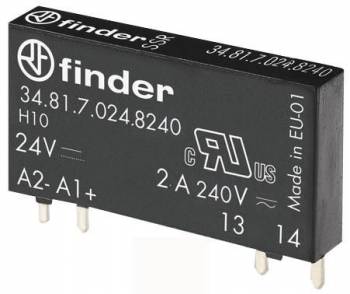
Finder 348170248240 SSR 1S 230VAC 2A narrow
| Lieske Part No. | 675512 |
|---|---|
| Mfg Part No | 348170248240 |
| EAN-Code | 8012823285788 |
| Manufacturer | Finder |
| Here only | 604,20 EUR
719,00 EUR incl. VAT
|
Further information for Finder 348170248240 SSR 1S 230VAC 2A narrow
| General | |
| Input voltage | 24 V DC |
| Input current | 7 mA |
| Output voltage | 12-275 V AC |
| Max. output continuous current | 2 A |
| Relay protection class | RT III |
| Construction type | Narrow |
| Coil power | 170 mW |
| Response time | 5 ms |
| Reset time | 3 ms |
| Voltage rating input/output | 3000 V AC |
| Ambient temperature | -40…+85 °C |
| Contact material | AgNi |
| Switching function | 1-pole normally open contact (NO) |
| Mounting method | circuit board or socket series 93 |
| Socket compatibility | Series 93 |
Applications
This relay is designed for use in industrial control systems where reliable, disturbance-free switching of loads is required. Typical application areas include automation technology, especially in the packaging industry, street and tunnel lighting, and programmable logic controllers (PLC). The contactless switching enables noiseless and fast switching, which is particularly advantageous for frequent switching operations.
Functions and Equipment in Detail
The relay features an electronic input with a rated voltage of 24 V DC and an input current of 7 mA. The output voltage ranges from 12 to 275 V AC, with a maximum continuous output current of 2 A. The switching function is performed via a single-pole normally open contact. The device is designed for operation in environments with temperatures from -40 °C to +85 °C, enabling use in harsh industrial environments. The contact materials consist of AgNi, ensuring high switching durability and corrosion resistance.
Technology Explained Simply
The relay operates as a solid-state relay (SSR), where switching is performed electronically via an optocoupler. This means there are no mechanical contacts, which increases the service life and enables noiseless switching. The input power is 170 mW, representing low coil power and allowing control with minimal energy. The voltage rating between input and output circuits is 3000 V AC, ensuring high galvanic isolation. The response and release time are 5 ms and 3 ms respectively, suitable for fast switching operations.
Compatibility and Accessories
The relay can be mounted directly onto printed circuit boards or onto sockets of series 93, which are equipped with screw, spring-cage, or push-in terminals. Compatible sockets include types 93.61.7.024, 93.51.7.024, 93.01.0.024, 93.51.0.024, 93.60.7.024, 93.01.7.024, 93.63.7.024, 93.67.7.024, and 93.11. These sockets allow flexible mounting on support rails (35 mm according to EN 60715) or directly onto printed circuit boards. Control is via AC/DC voltage, with series 93 sockets providing the connection.
Mounting and Installation
Mounting is done either directly onto a printed circuit board or via a series 93 socket mounted on a support rail (35 mm). The sockets offer various connection types, including screw terminals, spring-cage terminals, and push-in terminals, to adapt the installation to specific requirements. The narrow design of 5 mm allows dense mounting in compact devices.
Operational Advantages
The relay offers a high electrical service life of 60,000 switching cycles under AC1 operation, ensuring long-term reliability in industrial applications. The contactless switching prevents mechanical wear and enables noiseless switching. The high galvanic isolation of 3000 V AC between input and output circuits ensures safe separation of switching circuits. The relay protection class RT III ensures the reliability of the device in demanding environments.

This is an offer of:
79279 Vörstetten
https://industry-electronics.com
Tel. 07666/88499-0
Fax. 07666/88499-111
Diesen Artikel finden Sie unter:
industry-electronics.com/artikel/675512

Lieske Elektronik e.K.
Reutener Str. 1079279 Vörstetten
https://industry-electronics.com
Tel. 07666/88499-0
Fax. 07666/88499-111
Diesen Artikel finden Sie unter:
industry-electronics.com/artikel/675512