
ELSYS ELT2i LoRa Sensor Temp/Humidity/Pressure/Acceleration
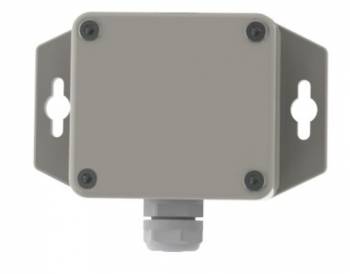
ELSYS ELT2i LoRa Sensor Temp/Humidity/Pressure/Acceleration
| Lieske Part No. | 1547369 |
|---|---|
| Mfg Part No | ELT2i |
| EAN-Code | |
| Manufacturer | ELSYS |
| Here only | 100,05 EUR
119,06 EUR incl. VAT
|
Further information for ELSYS ELT2i LoRa Sensor Temp/Humidity/Pressure/Acceleration
| General | |
| Degree of protection | IP67 |
| Communication technology | LoRaWAN |
| Battery runtime | up to 10 years |
| Battery voltage | 3,6 V |
| Internal sensors | Temperature, humidity, acceleration, air pressure |
| Number of generic inputs | 2 |
| Configuration technology | NFC |
| Additional modules | ADC module, EXT module |
| Battery included | |
Applications
The ELT-2 is suitable for applications in smart city development, agriculture, industry, and environments with extreme weather conditions. It can be used in exposed areas such as containers, construction sites, or rural areas where reliable remote transmission of measurement data is required. The combination of a robust housing and long battery life makes it ideal for decentralized, low-maintenance measurement systems.
Functions and Equipment in Detail
The sensor features four internal sensors: a temperature sensor, a humidity sensor, an accelerometer, and a barometric pressure sensor. These enable simultaneous acquisition of multiple environmental parameters. Additionally, the ELT-2 offers two generic inputs that can be configured for various applications, including external temperature sensors, pulse counting, analog input 0–10 V, digital input, water leak detection, switches, distance sensors, or soil moisture sensors. Configuration is performed via near-field communication (NFC) using an Android smartphone and the Sensor Settings application, allowing individual adjustment of parameters such as sampling rate, data rate, encryption key, triggers, and activation.
Technology Explained Simply
The ELT-2 uses the LoRaWAN® protocol for wireless data transmission, known for its long range and low bandwidth usage. The internal antenna ensures uniform signal radiation in all directions, guaranteeing installation location and orientation independence. Battery life can last up to 10 years, with actual lifespan depending on factors such as sampling interval, transmission interval, data rate, and environmental conditions. Power supply is via a 3.6 V AA battery, suitable for the ERS series and ELT-1/ELT-2HP.
Compatibility and Accessories
The ELT-2 can be extended with additional modules. The ADC module enables connection of PT1000 platinum sensors or serves as a universal bridge amplifier, for example, for measuring extreme temperatures or connecting a load cell. The EXT module extends functionality, allowing the sensor to operate as a Class-C or Class-A device. It enables connection of external sensors such as lightning detectors, external power supplies (0–10 V), or control of actuators/relays. As accessories, external temperature sensors with cables in lengths of 1, 3, and 5 meters are available and can be directly connected to the ELT-2.
Mounting and Installation
Mounting the ELT-2 is simple and requires no special tools. The IP67 housing protects the device against moisture and dust, enabling operation even in humid or dusty environments. The internal antenna allows flexible placement, as signal quality remains independent of device orientation. Installation typically occurs on a fixed surface, with mounting points provided in the housing.
Advantages in Operation
The ELT-2 offers high flexibility through the combination of internal sensors and expandable inputs. NFC-based configuration enables quick and easy parameter adjustment on-site. The long battery life reduces maintenance frequency, and the robust design ensures reliable operation even under challenging conditions. Compatibility with various additional modules expands application possibilities, making the sensor a modular solution for different measurement tasks.
Batteries are not included in the delivery scope.

This is an offer of:
79279 Vörstetten
https://industry-electronics.com
Tel. 07666/88499-0
Fax. 07666/88499-111
Diesen Artikel finden Sie unter:
industry-electronics.com/artikel/1547369

Lieske Elektronik e.K.
Reutener Str. 1079279 Vörstetten
https://industry-electronics.com
Tel. 07666/88499-0
Fax. 07666/88499-111
Diesen Artikel finden Sie unter:
industry-electronics.com/artikel/1547369