
Elecfreaks EF08413 Space Science Kit without micro:bit
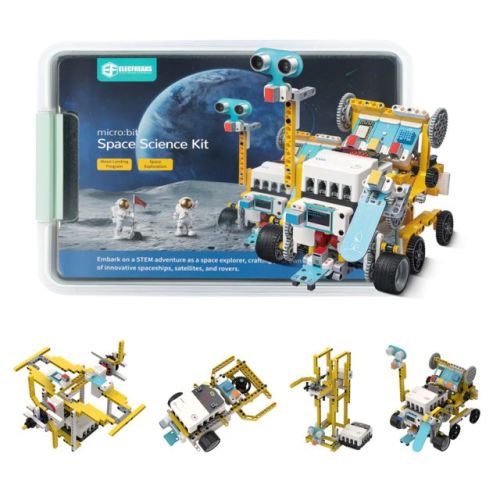
Elecfreaks EF08413 Space Science Kit without micro:bit
| Lieske Part No. | 822604 |
|---|---|
| Mfg Part No | EF08413 |
| EAN-Code | |
| Manufacturer | Elecfreaks |
| Here only | 147,47 EUR
175,49 EUR incl. VAT
|
Further information for Elecfreaks EF08413 Space Science Kit without micro:bit
| General | |
| Manufacturer | Elecfreaks |
| Product type | MINT training kit |
| Components | Nezha Breakout Board V2, PlanetX Smart Motor, PlanetX Sensors, scenario-based map of lunar landing plan, building blocks |
| Target group | primary and secondary school students |
STEM education kit for school use
It integrates the Nezha Breakout Board V2, which serves as an interface between the micro:bit and connected components. This board enables control of motors and sensors via the micro:bit board, allowing students to directly interact with programming. The scenario-based moon landing plan map serves as a visual guide and structures learning activities within a thematic context.
Functions and equipment in detail
Central components of the kit include the PlanetX Smart Motor, used for drive functions in built models. This motor is equipped with an integrated encoder, enabling precise motion control and position monitoring. Additionally, several PlanetX sensors are included in the kit, designed to measure various physical quantities such as light, temperature, motion, or environmental conditions. These sensors can be used in projects to program reactions to environmental changes, for example, simulating landing conditions on the Moon.
Technology explained clearly
The technology of the kit is based on the integration of hardware and software. The Nezha Breakout Board V2 acts as an electronic interface, forwarding signals from the micro:bit board to connected components. The PlanetX sensors provide data that is transmitted via the board to the micro:bit board for processing. Students program the behavior of the models using a graphical or text-based development environment available for the micro:bit board. The building blocks included in the kit allow for mechanical assembly of models, such as wheels, axles, or frames, required for simulating vehicles or landing craft.
Compatibility and accessories
Compatibility with the micro:bit board is ensured by the Nezha Breakout Board V2, which functions as an adapter. The PlanetX sensors and PlanetX Smart Motor are also designed for use with the micro:bit board. The scenario-based moon landing plan map serves as a learning aid and is part of the kit. The building blocks are standardized and can be flexibly combined to create various constructions.
Assembly and installation
Assembly is performed by mechanically connecting the building blocks, where students assemble individual components such as wheels, axles, and frames. Electronic components, including the Nezha Breakout Board V2, PlanetX Smart Motor, and sensors, are connected to the micro:bit board via appropriate connectors. Programming is done through a development environment accessible via a computer or tablet. Students can directly transfer programs to the micro:bit board to test the functions of the built models.
Advantages in operation
The kit offers a practical introduction to STEM education by actively involving students in planning, construction, and programming of projects. The scenario-based structure of learning content promotes structured thinking and problem-solving skills. The use of real sensors and motors allows direct observation and analysis of physical phenomena. The combination of mechanical parts and electronic components creates a comprehensive learning environment that fosters skills in various technical disciplines.

This is an offer of:
79279 Vörstetten
https://industry-electronics.com
Tel. 07666/88499-0
Fax. 07666/88499-111
Diesen Artikel finden Sie unter:
industry-electronics.com/artikel/822604

Lieske Elektronik e.K.
Reutener Str. 1079279 Vörstetten
https://industry-electronics.com
Tel. 07666/88499-0
Fax. 07666/88499-111
Diesen Artikel finden Sie unter:
industry-electronics.com/artikel/822604