
Moeller LP-CC-1/2 NH fuse 0.5 A slow
Installation > Securing material > NH fuses and accessories
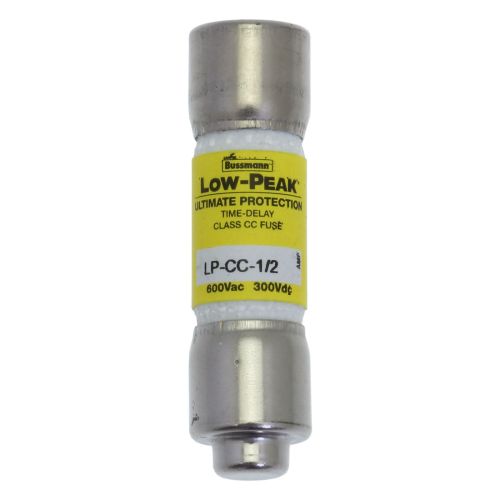
Moeller LP-CC-1/2 NH fuse 0.5 A slow
| Lieske Part No. | 2144482 |
|---|---|
| Mfg Part No | LP-CC-1/2 |
| EAN-Code | 5027590096652 |
| Manufacturer | Eaton |
| Here only | 544,41 EUR
647,85 EUR incl. VAT
|
Further information for Moeller LP-CC-1/2 NH fuse 0.5 A slow
| Technical details | |
| Power supply type | AC |
| Purpose | Standard |
| Fuse type | Cylindrical |
| Maximum current | 0.5 A |
| Operating class | CC |
| Voltage | 600 V |
| Housing material | Melamine |
| Nominal input voltage | 600 V |
| Nominal current output | 0.5 A |
| Product colour | Silver |
Applications
This fuse is designed for use in low-voltage installations, particularly in systems requiring high reliability and precise protective functions. It is suitable for applications where a time-lag switching characteristic is necessary to withstand short-term current surges, such as those occurring during the startup of motors or other inductive loads, without triggering the fuse. Its intended use is in electrical circuits with an operating voltage up to 600 V AC. The fuse is designed to be confusion-proof to prevent incorrect installation.
Functions and Features in Detail
The fuse is designed as a time-lag (slow-blow) type, meaning it does not immediately trip during short-term overloads below twice the rated current. At a current of 200 % of the rated current (i.e., 1.0 A), the minimum tripping time is 12 seconds. This allows the fuse to tolerate short-term current surges that occur during device startup without interrupting the circuit. The fuse has a cylindrical shape with dimensions of 10 x 38 mm, making it suitable for standard fuse holders. Its design as a fuse insert enables easy installation into corresponding fuse holders.
Technical Explanation
The time-lag switching characteristic of the fuse is based on a special design of the fuse element, which does not melt immediately during short-term overloads. This is particularly important in installations where electrical devices with high inrush currents are operated, such as motors or transformers. The fuse only trips during sustained overloads or short-circuit currents. The interrupting capacity is 200 kA, meaning the fuse can safely interrupt short-circuit currents up to this level. The rated voltage of 600 V AC defines the maximum operating voltage range in which the fuse functions safely. Operating class CC is a classification indicating specific application and protective function.
Compatibility and Accessories
The fuse is designed for use in standard fuse holders intended for low-voltage installations with a rated voltage up to 600 V AC. The dimensions of 10 x 38 mm correspond to the standard format for fuse inserts of this rating class. The fuse is designed to be confusion-proof to prevent incorrect installation. Compatibility with fuse holders supporting operating class CC is ensured. The fuse is UL-approved, indicating compliance with American standards.
Installation and Mounting
Mounting is performed in standard fuse holders designed for low-voltage installations. The fuse is inserted into the holder and secured by the holder mechanism. Tools are generally not required, as the fuse is mounted by simple insertion into the holder. Installation is carried out in electrical circuits with an operating voltage up to 600 V AC. The fuse is intended for use in enclosed switchgear, where environmental conditions must meet the requirements of the applicable standards.
Operational Advantages
The time-lag switching characteristic allows the fuse to tolerate short-term current surges without tripping, enhancing operational safety and preventing unnecessary interruptions. The interrupting capacity of 200 kA ensures safe interruption during short-circuit currents. The use of melamine as housing material provides high electrical insulation and heat resistance. The confusion-proof design reduces installation errors. UL approval demonstrates compliance with international safety standards.

This is an offer of:
79279 Vörstetten
https://industry-electronics.com
Tel. 07666/88499-0
Fax. 07666/88499-111
Diesen Artikel finden Sie unter:
industry-electronics.com/artikel/2144482

Lieske Elektronik e.K.
Reutener Str. 1079279 Vörstetten
https://industry-electronics.com
Tel. 07666/88499-0
Fax. 07666/88499-111
Diesen Artikel finden Sie unter:
industry-electronics.com/artikel/2144482