
Moeller 285603 PFR-W-140 converter for RCD relay
Industrial Material > Control devices / Pilot devices > Breakers and disconnectors
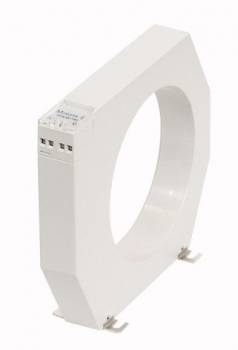
Moeller 285603 PFR-W-140 converter for RCD relay
| Lieske Part No. | 144144 |
|---|---|
| Mfg Part No | 285603 |
| EAN-Code | 4015082856038 |
| Manufacturer | Eaton |
| Here only | 966,08 EUR
1.149,64 EUR incl. VAT
|
Further information for Moeller 285603 PFR-W-140 converter for RCD relay
| General | |
| Manufacturer | Eaton |
| Utilization | For RCD relays |
| Diameter | 140 mm |
| Compatibility | NZM1, NZM1-4, N1, N1-4, NZM2, NZM2-4, N2, N2-4, NZM3, NZM3-4, N3, N3-4, NZM4, NZM4-4, N4-4 |
| Mounting method | Screw mounting |
| Alternative mounting | mounting clip for DIN rail mounting |
| Approval | not UL/CSA-approved |
| Technical guideline | transformer diameter must be 1.5 times larger than conductor sheath diameter |
Applications
The current transformer PFR-W-140 is designed for use in electrical installations equipped with NZM series circuit breakers. It is suitable for installations with rated voltages up to 1000 V and is used in various variants of the NZM series, including NZM1, NZM2, NZM3, NZM4, as well as their 4-pole variants. Its use is particularly common in industrial environments where high safety standards against fault currents are required. The transformer is not UL/CSA-approved, which must be considered during planning for markets with corresponding certification requirements.
Functions and Equipment in Detail
The transformer serves as a sensor for fault currents, which are detected and processed by the RCD relay. It is mounted around the through-conductor, with technical guidelines specifying that the transformer’s diameter must be at least 1.5 times larger than the outer diameter of the conductor. This ensures reliable measurement of the magnetic flux and thus precise fault current detection. The modular design enables flexible and easy installation onto NZM series circuit breakers.
Technology Explained Simply
A current transformer such as the PFR-W-140 detects the magnetic flux generated by current flow in the conductor. In the event of a fault current, such as insulation failure or earth short-circuit, an imbalance in current flow occurs, which the transformer detects. This signal is transmitted to the RCD relay, which then triggers disconnection of the affected circuit. The transformer’s 140 mm diameter allows use with relatively thick conductors, which is common in industrial installations. Mounting directly onto the circuit breaker creates a compact and integrated solution.
Compatibility and Accessories
The transformer is compatible with a wide range of NZM series circuit breakers, including models NZM1, NZM2, NZM3, NZM4, as well as their 4-pole variants. It can be combined with various circuit breakers and switch disconnectors available as accessories, such as models N3-4-400-S15-DC, NZMN4-ME875, NZMN3-4-A500, or N4-4-1600-S1-DC. Combining it with these breakers enables comprehensive protection functions in complex switchgear installations.
Mounting and Installation
Installation of the PFR-W-140 is performed via screw mounting directly onto the circuit breaker. Alternatively, a mounting clip for DIN rail mounting can be used, enabling flexible installation in enclosures. Adherence to the technical guideline regarding the diameter ratio between transformer and conductor is crucial for functionality. Installation is typically carried out by qualified electricians who comply with relevant standards and safety requirements.
Operational Advantages
Using the PFR-W-140 increases safety in electrical installations by detecting fault currents early and triggering disconnection. The modular design and simple installation reduce installation time and costs. Compatibility with various NZM circuit breakers allows flexible adaptation to different installation configurations. Integration into existing switchgear requires no extensive modifications, simplifying maintenance and expansion. Reliable fault current detection contributes to preventing damage and ensuring operational safety.

This is an offer of:
79279 Vörstetten
https://industry-electronics.com
Tel. 07666/88499-0
Fax. 07666/88499-111
Diesen Artikel finden Sie unter:
industry-electronics.com/artikel/144144

Lieske Elektronik e.K.
Reutener Str. 1079279 Vörstetten
https://industry-electronics.com
Tel. 07666/88499-0
Fax. 07666/88499-111
Diesen Artikel finden Sie unter:
industry-electronics.com/artikel/144144